
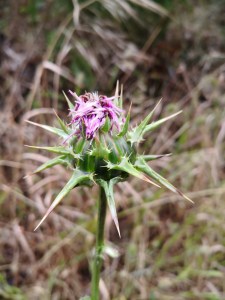
Common names: Milk Thistle, Scotch Thistle, Saint Mary’s Thistle, Variegated Thistle
Taxonomic name: Silybum marianum
Family: Asteraceae
Uses: food, liver tonic and cleanser
Area of origin: England
Warnings: Take it easy with this one, it really works and is quite strong in its effects. Animals can be affected by the Potassium Nitrate content.
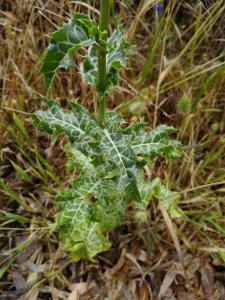
Milk Thistle is a native of old England. It has one of the most memorable botanic names ‘Silybum marianum‘ – when I was learning all of this, I used to pronounce it ‘Silly Bum’ as a mnemonic.
Milk Thistle is probably one of the most widely used herbs and I’ve even seen folks who dismiss herbs as medicine using commercial capsules of it.
It is quite edible, though I prefer Sow Thistle (Sonchus oleracus) as it is softer and greener and slightly less bitter. The roots of Milk Thistle can be eaten raw but taste much better roasted. You can trim the spines from younger leaves and use them as a leafy green in your cooking and eat the young shoots too. Even the bracts from the flower heads are edible in a similar way to Globe Artichoke or Wild Artichoke.
Herbally, Milky Thistle is one of the great liver tonics and cleansers. It stimulates gall production and excretion and really flushes that organ out. It is used in combination with other herbs in treating other liver complaints such as hepatitis.
Remember that our Liver is a powerhouse of transformation. It has many, many functions that contribute to our health. It is so active that it contributes greatly to our body warmth!. Look after your Liver with bitter herbs such as Milk Thistle and it’ll look after you!


2 responses to “Milk Thistle (Silybum marianum)”
I am growing milk thistle to cleanse my liver. Can you recommend a tonic recipe?
LikeLike
Thanks for commenting, Cornelia.
Milk Thistle is pretty potent in its actions yet still gentle.
I’d combine it in a tea or infusion with something soothing to the gut such as Chamomile or Fennel and Burdock to help feed the gut bacteria. Fennel is another gentle liver tonic so will combine well.
I hope that helps
M
LikeLike