I originally wrote about glycerites in Grass Roots magazine, No. 284. It was only a short article, so here’s a heap more info.
Glycerites are sweet, warming remedies made using glycerine (aka glycerol) as the solvent. They’re suitable for folks who don’t partake of alcohol in any form, kids and pregnant people. They have become my favourite way to make and take remedies.
As a solvent, glycerine is stronger than water or vinegar but less effective at extracting constituents than alcohol. Glycerine has particular properties that make it a useful additive to tinctures – we’ll go into that on the tincturing pages.
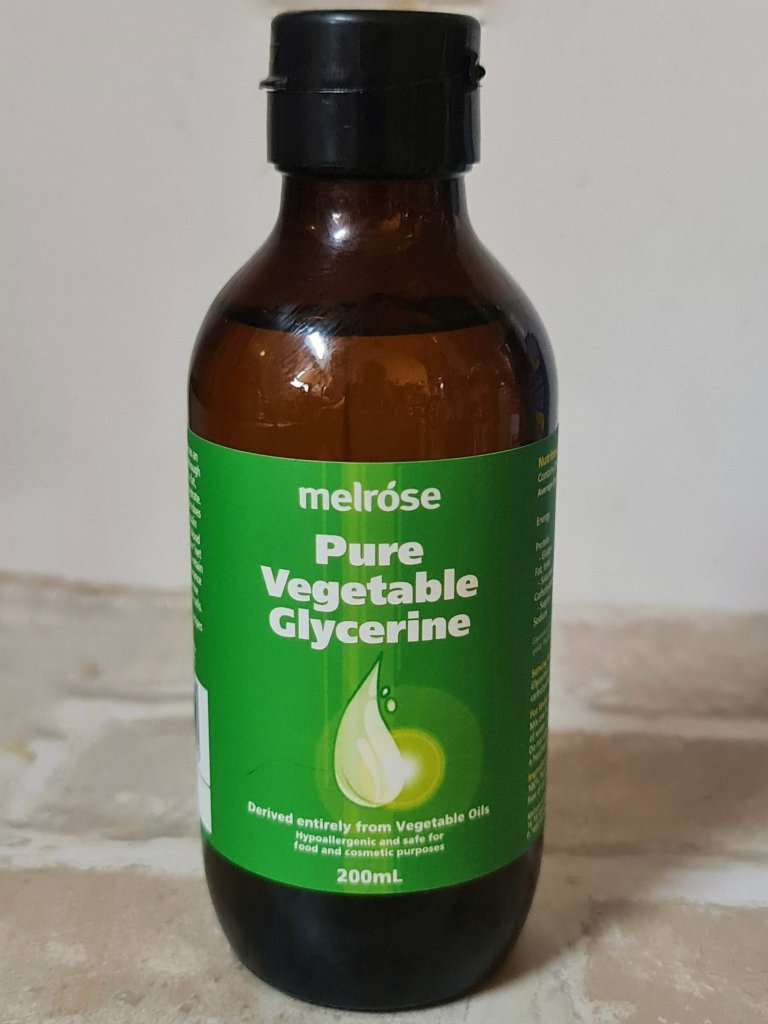
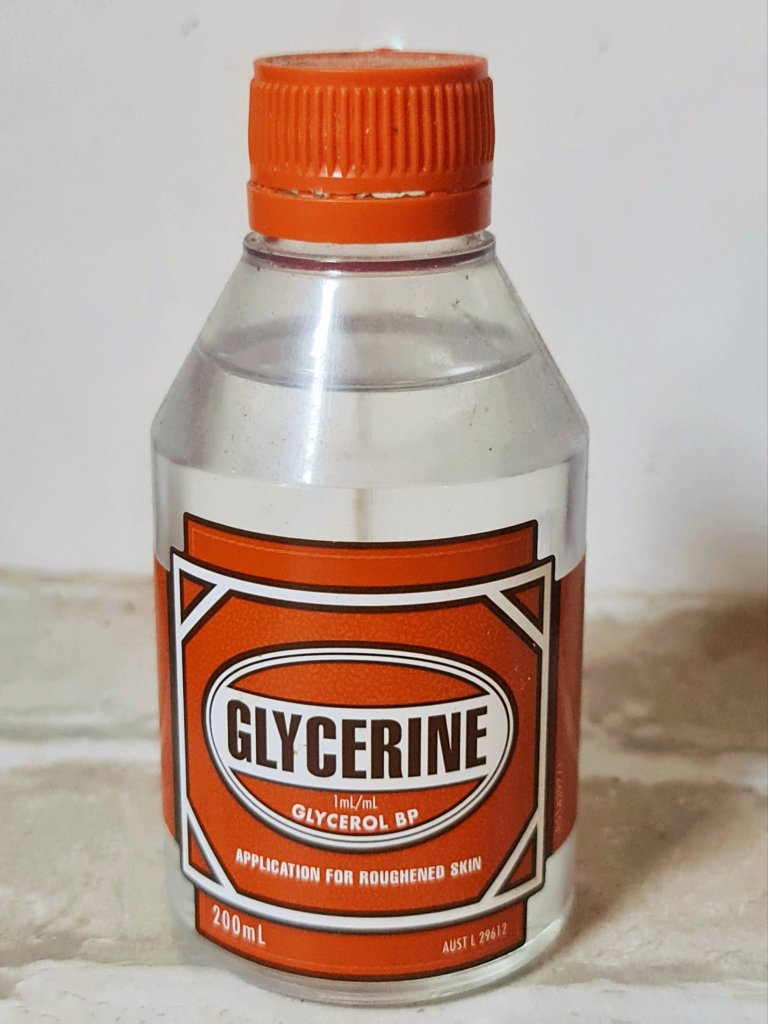
Glycerine is cheaper than alcohol to buy too – you can get 5 litres of food grade, organic vegetable glycerine, made to the standards of the British Pharmacopoeia, for about $50 (plus postage of course) online in 0z. I get mine from Envirochem in Australia.

What is glycerine?
Food grade glycerine is the product of the fermentation of sugars or the hydrolysis of oils and fats. Hydrolysis is a chemical reaction where water breaks one or more of the chemical bonds in a molecule, effectively creating something new. Glycerine can be chemically manufactured and still labelled ‘food grade’.
Much of the commercially available glycerine is a product of industrial soap manufacturing, so watch out for the quality. If you’re a home soap maker yourself, you may be able to make yourself a regular supply. At least you’ll be sure of the quality.
Much glycerine is produced from animal fat but there are vegan, kosher versions and those that are made to the standards of the American Pharmacopoeia. The one I use ticks all of those boxes.
Glycerine is a viscous liquid with a sweet taste and does contribute to our caloric intake. It is a humifactant, absorbing moisture easily, even from the air, though it is used as an emollient in herbalism and the beauty industry where its properties are used to carry other moisturizing ingredients to dry tissues. Its soothing, emollient effect can be used to hydrate tissues by pulling moisture from deeper tissue layers, as well as the gut, where it is used as a laxative.
Glycerine isn’t a sugar, though it is sweet. It is closer to alcohol in nature, that means that it isn’t digested in the sane way as sugars and doesn’t spike blood sugar in people, though when you think about it from the viewpoint of energetic herbalism, the sweet taste does prepare the body for a sweet substance. I know some diabetics who can use glycerine and not have blood sugar issues and I know one who does have them from it, so if you have blood sugar issues, be cautious and try a little glycerine, testing blood sugar levels before and after taking it to be sure of how YOUR body responds. Remember, in herbalism, everybody is an individual,with individualised responses to things
Glycerine also have a reasonable calorific value, so will eventually contribute to a few extra pounds of you’re not careful.
Medicinal characteristics of glycerine
Glycerine is sweet and has a warming effect on tissues. It will actually pull moisture from the air, which is why glycerine is usually 95% Glycerine, the other 5% being water.
Glycerine can be used to dry, moist or damp tissues or to hydrate them. It can dry because when in contact with a surface, it starts to absorb moisture. It can also moisten because it is so good at absorbing moisture, that it can pull in moisture from tissues below those it is in contact with!
This means, it can moisten dry, atrophied tissues by pulling fluids from deeper, damp tissues – a two in one effect!
Using glycerine
When using glycerine as a solvent, there is a little difference between using fresh and dry herbs because of their moisture content.
As mentioned earlier, glycerine loves water and will even pull it out of the air! But by itself doesn’t make the best solvent for water soluble compounds. The solution to that is to add a little water to your glycerine. Not much is needed, 25 % for dried herbs to help rehydrate them and 20% for fresh herbs. It’s not a lot of difference but it helps greatly. It is a very forgiving process, so a few % either way won’t make a lot of a difference unless your’e pretty obsessive.
My favourite herbs for glycerites
I love to use herbs that emphasise glycerine’s sweet, soothing nature. Many of the Mint Family such as Lavender or Lemon Balm make beautiful glycerites. The Rose family too are effective if prepared and used in this manner. Wild Rose and Hawthorn work beautifully.
Others to consider are Elderberries, Rose Hips, Peppermint or Scullcap. Even Prickly Lettuce makes a reasonable pain relieving glycerite for which the glycerine eases a little of the herb’s bitter taste.
Making a glycerite
You make basic glycerites in the same way we make Folk tinctures but for some herbs, we use the same method that we use for making infused oils using heat.
Super simple method-
There is s super simple method that only requires eyeballing quantities. All you need to do is add your herb to a jar until the jar is half full.
- Then add glycerine until the jar is half filled with it.
- Next add a quantity of water that is approximately 50% of the amount of glycerine.
- Put a lid on your jar and shake, shake shake.
- Shake daily for a couple of weeks , strain and bottle.
- Easy!
Basic cold method –
Most herbs, especially aromatic ones will extract nicely in glycerine without the application of any heat. This is by far the best method for fresh herbs. A great glycerite to make with the cold method is Rose Petals. It’s a soothing, cooling remedy that can have a magnificent colour, depending on the colour of Rose you use.
- Get a good handful of fresh Rose petals, chop them coarsely and half fill a jar with them. You can use dried petals but fresh ones are much better.
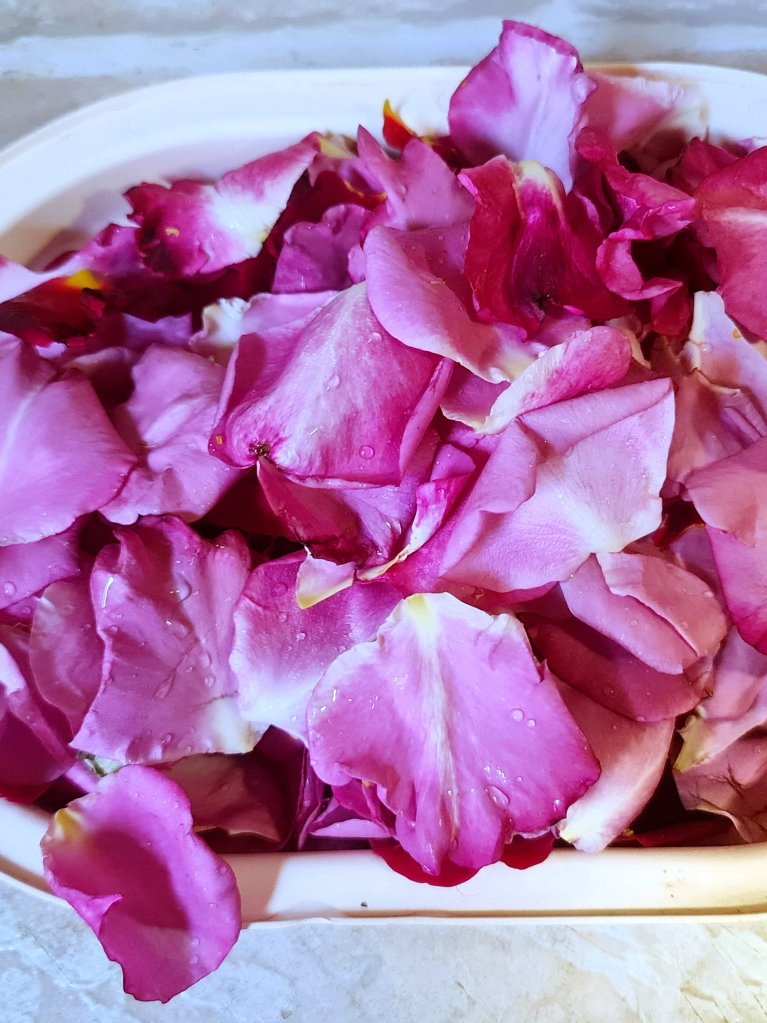
- Half fill the jar with a mix of 80% glycerine to 20% water. That’s the is the best ratio to extract most herbal constituents from suitable fresh herbs.

- Seal the jar and give it a good shake. Shake it every day for 2 -3 weeks. After the mass of Rose petals has settled and lost some of their colour, add a handful of fresh ones. Just make sure that the herb is always covered by the glycerine. Check out the beautiful colour in the pics. I use a combination of coloured petals picked from around the neighbourhood but if you have a favorite, nicely coloured and scented Rose, definitely use that.
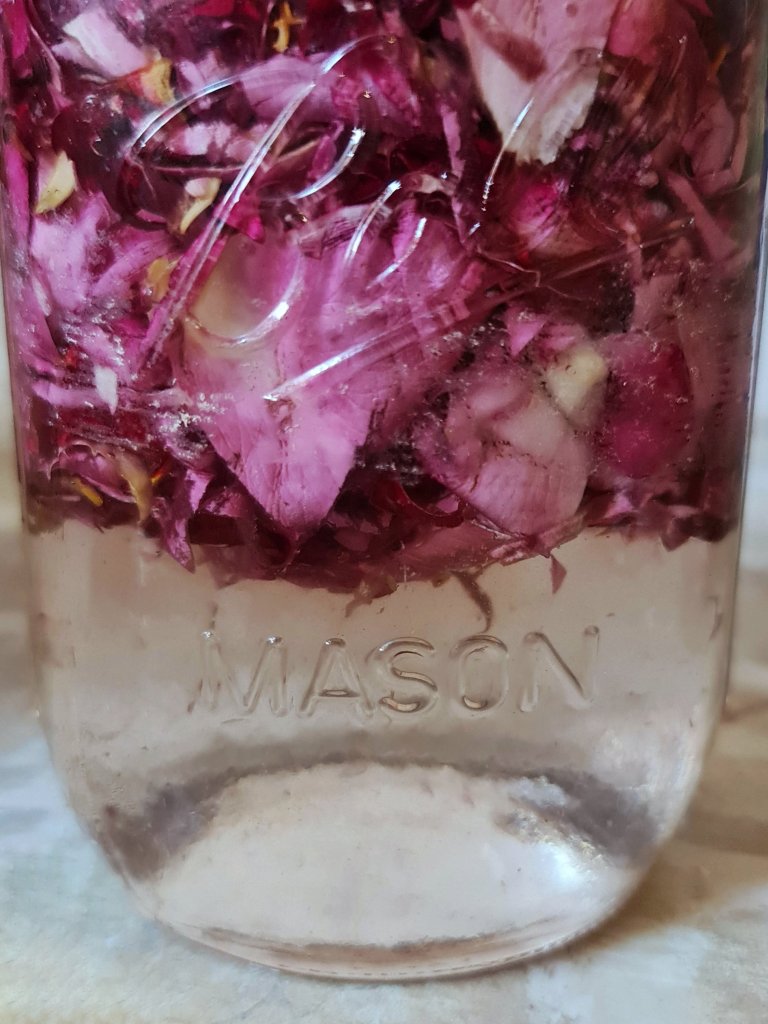
- Your Rose petals will float to the top. That’s OK, just push them back down. They’ll get the idea after a while, especially with a few daily shakes.

- Strain the mix and bottle it. A wide strainer lined with cheesecloth works best but be prepared to wait, glycerine is pretty thick and takes its time to drain through your filter. For small amounts, after a run through a coarse strainer, I like to use these small coffee filters (see pic below) that have a fine inside liner.

- Bottle your glycerite and keep somewhere cool and out of the light. It will last a couple of years in storage if you can resist taking it too frequently. If you’re planning to store it for a while, a little vitamin C can extend its shelf life.
Don’t forget that other herbs can be used instead of Rose. Hawthorn makes a beautiful heart supporting glycerite, Elderberry, an immune supporting one and Lemon Balm glycerite is just heavenly!
If you’re finding this information useful, share it with your community
Ratio method
Like tinctures and oils, you can get more consistent results by using a ratio of solvent to herb. You will find your own favourites but the recommended ratio for fresh herbs is 1 part herb : 2 parts glycerine.
Don’t forget that your glycerine should be combined with water for the best extraction results. Use the standard 75% -25% glycerine to water ratio.
As an example, you want a 1:2 ratio of Lemon Balm : glycerine and have 100 grams of Lemon Balm. You will therefore need 200 ml of glycerine/water combination. That will be 150 ml of glycerine and 50 ml of water.
If you’re using ann 80% : 20% combination of glycerine and water for the same amount of herb, your amounts will be 160 ml of glycerine and 40 ml of water.
Hot method

This method is better suited to dried herbs and some herbs that extract better with a little warmth. For fresh herbs, use 80% glycerine : 20 % water because there is already water in the herbs. For dried herbs, use the regular 75% – 25% ratio so that the extra water can help rehydrate the herbs. This technique is faster than the cold method, giving you a turn around time of 2 – 3 days as opposed to 2 – 3 weeks.
The easiest way I’ve seen to heat them gently is to 1/4 – 1/3 fill a slow cooker with water and place your herb and glycerine in sealed jars mix into this. Keep the slow cooker on its lowest setting and use a timer to turn it on and off at intervals – 1/2 – 1 hour on to 1 hour off. The exact time will depend on your particular slow cooker and how hot it runs.
I’ve found that cookers such as the one pictured above tend to be hotter that the traditional crock pot. If your cooker is getting near boiling, leave the lid partially open or even off. The idea is to get hot but not boiling water.
Leave your jars to infuse for 48 hours and check. They should be good by then but a little longer won’t hurt as long as the water temperature isn’t too high.
Catnip, Cinnamon and Ginger are the only herbs I’ve tried extracting with the hot method.
Making larger amounts
If you want to make a larger amount of glycerite using the warming method, you can dispense with the jars and the water bath and put your herbs and glycerine straight into your cooker. Fill the cooker to around 60% of its capacity so there is plenty of room for movement. I can’t resist stirring it from time to time to check out how it is progressing (and to sneak a little taste).
For fresh herbs, use the ratios mentioned above : 80% glycerine : 20 % water because there is already water in the herbs. For dried herbs, use the regular 75% – 25% ratio so that the extra water can help rehydrate the herbs.
Increasing the strength
As I’ve mentioned in other pages on remedy making, you can really boost the strength of a remedy by using a herbal infusion instead of water . This gives you a choice of adding an infusion of the same herb that you are using in a glycerite or another herb that you may wish to use, especially one that extracts better in water.
Combining glycerites
I usually like to make my tinctures and oils separately, then mix together what I need. This allows me to customise the blend for individuals. It also saves having a heap of a mix sitting around on a shelf. Another plus to this idea is that I have more of the individual oils or tinctures to play around and experiment with.
The glycerites that are best made with the warming method seem better made when combined together in one cooker during the remedy making process.
Using your remedy
Simply take a teaspoonful or your remedy three to four times a day. You can have it straight or, if like me, you find glycerine to be too sweet, mix it with a glass of water.

Rose and Lemon Balm glycerites can be used as needed to when feeling stressed or about to enter into a stressful situation. Rose calms the heart and brings peace and clarity, Lemon Balm eases anxiety and stomach troubles caused by it. The delicious taste of Rose, combined with the sweetness of glycerine, makes this remedy a great way to give yourself some inner peace.
Glycerites are a great way to get children to take their herbs. Kids have a particular love for Lemon Balm, so a Lemon Balm glycerite is irresistible.
Glycerites are also suitable for folks recovering from long term illness, especially those that have wasted a lot of their energy and body mass.
For a much more detailed dive into the world of glycerites-
I really enjoyed Nicole Rose’s ‘Making Herbal Medicine with Glycerine‘ course through her Solidarity Apothecary website. She has several great courses there and offers a solidarity price that allows people who don’t have the financial means to pay any or part of the course. You can also just donate what you can as payment.
I’ll be frank and say that all of the information on this page is the result of me playing around and making remedies using Nicole’s techniques and modifying them for my own purposes and means. Checking other sources only reaffirms her ideas and I’ve really not found the need to look much further.
Other herb pages on Ligaya Garden
We cover a lot of ground on many herb related topics here on our website. There are whole pages devoted to different topics as well as frequent posts. Some of the links are –