The importance of homegrown herbalism lies in its natural and holistic approach to health and wellness.
Jelina Haines
Advice on herbalism and foraging in these pages and throughout our website is from a kitchen herbalist’s perspective and isn’t intended to replace medical diagnosis and recommendations. It is provided to enhance and encourage your own efforts to provide for your family and maybe add a little different perspective to your studies. Everything here is from my own personal study and experiences of using herbs and making remedies for my family and friends. This website is as much a diary of my own progress and learning as it is anything else, so, as I study to become qualified, I may change things a little here and there to reflect my growing knowledge and skills. There are reference pages on the website for all of the sources of information I have used in preparing this site in an organised manner.
If you are sick in any way for more than a couple of days, don’t hesitate to see a doctor.
Why use your own herbs in the first place?
Some folks ask, ‘Should they use herbs at all’? and I say, ‘It’s up to you. Are you happy with the service and medicines the medical industry gives?’. Some folks say herbs are expensive and dangerous; I say, ‘So are the industrial chemicals in your pharmaceutical pills and diet’. They only happen to be cheaper because of enormous subsidies given by governments, including our PBS. Every year, more medicines are taken off of that list. While still subsidised by the government, more of the cost is passed onto us.
Are herbs natural?
Interesting question. Glad I asked! Yes, herbal materials come from plants, but are they natural? When you buy a herb or remedy from your health food or natural health shop, the odds are that the product you buy is pre-packaged plant material that was harvested on a large scale, processed in factories, packaged, shipped and sold to you. Does that sound natural? It is better than the other alternative, I guess, and some products would have come from small farms and family businesses with a better ethical stance, but lots (especially those in the ‘health ‘section of your supermarket have been so mishandled and processed that they’re practically just packaged chemicals that may look like they were once plants. There is another way…
What is ‘kitchen ‘herbalism?
Kitchen herbalism is about making remedies for your family and friends from common materials using common kitchen equipment. Just like cooking, it’s a blend of art and science with a good handful of generous approximation mixed in for good measure.
You can get by with a minimum of equipment, most of which is probably already in your kitchen. As you progress and gain confidence with your remedy-making, you may want to expand into some more specific (shall I say ‘professional) items, but they’re not necessary at the start. Like any kitchen venture, kitchen herbalism is addictive and will grow by itself.
All you need to start being a kitchen herbalist is –
- a jar or two with with good lids
- a sieve
- cheesecloth
- a couple of spoons
- a measuring jug in millilitres
- a scale that measures in grams
- a couple of bowls
- herbs
- clean, unchlorinated water
- teapot or French Press (coffee plunger)
- Vodka (only necessary if you are making tinctures)
- this website ( and maybe a small donation so that we can continue giving this information free for everyone)
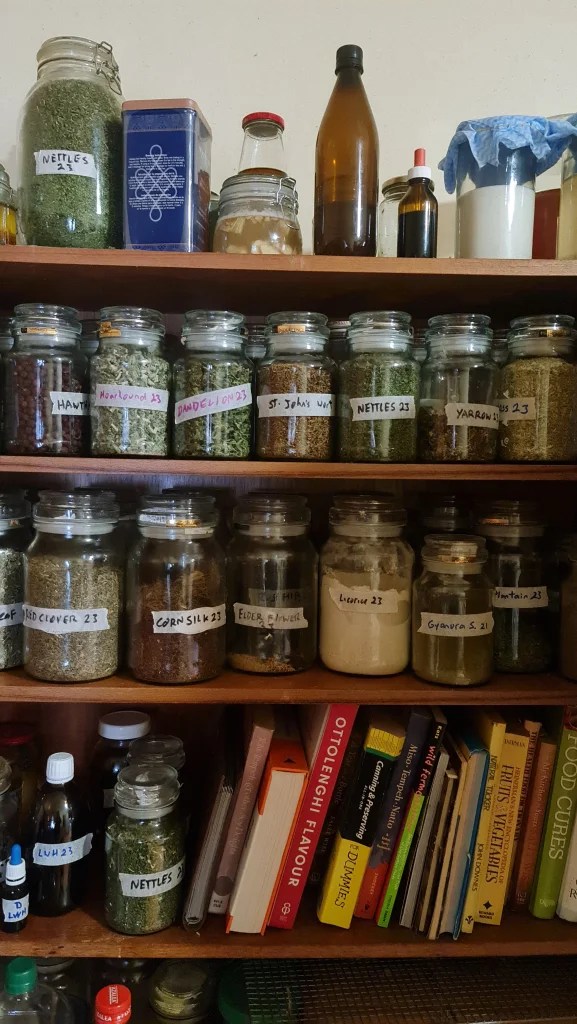
The herbs we deal with here are common plants easily found in your garden, a neighbour’s garden, or somewhere in the neighbourhood. If you can’t find them there, most are also available in your local health food store or supermarket (yuck!).
Kitchen herbalism is a broad field – what’s here is a guide for what we use at Ligaya Garden, but don’t feel restricted. You may already have some favourite herbs you use for healing or favourite books or cherished recipes from Mum. As long as you keep it informal and fun, you’ll be fine!
I am a self taught herbalist and forager, I currently have no formal qualifications in this field, just experience, observation and and private research skills.
These pages are more to inspire you to take up your own research and exploration and not are not intended to be
prescriptive – so I’ve got to include the caveat ”In the case of illness, see a licensed healer”.
Our herbal pages

(updated 07/05/25)