

Phylum: Basidiomycota. Class: Agaricomycetes. Order: Agaricales. Family: Agaricaceae
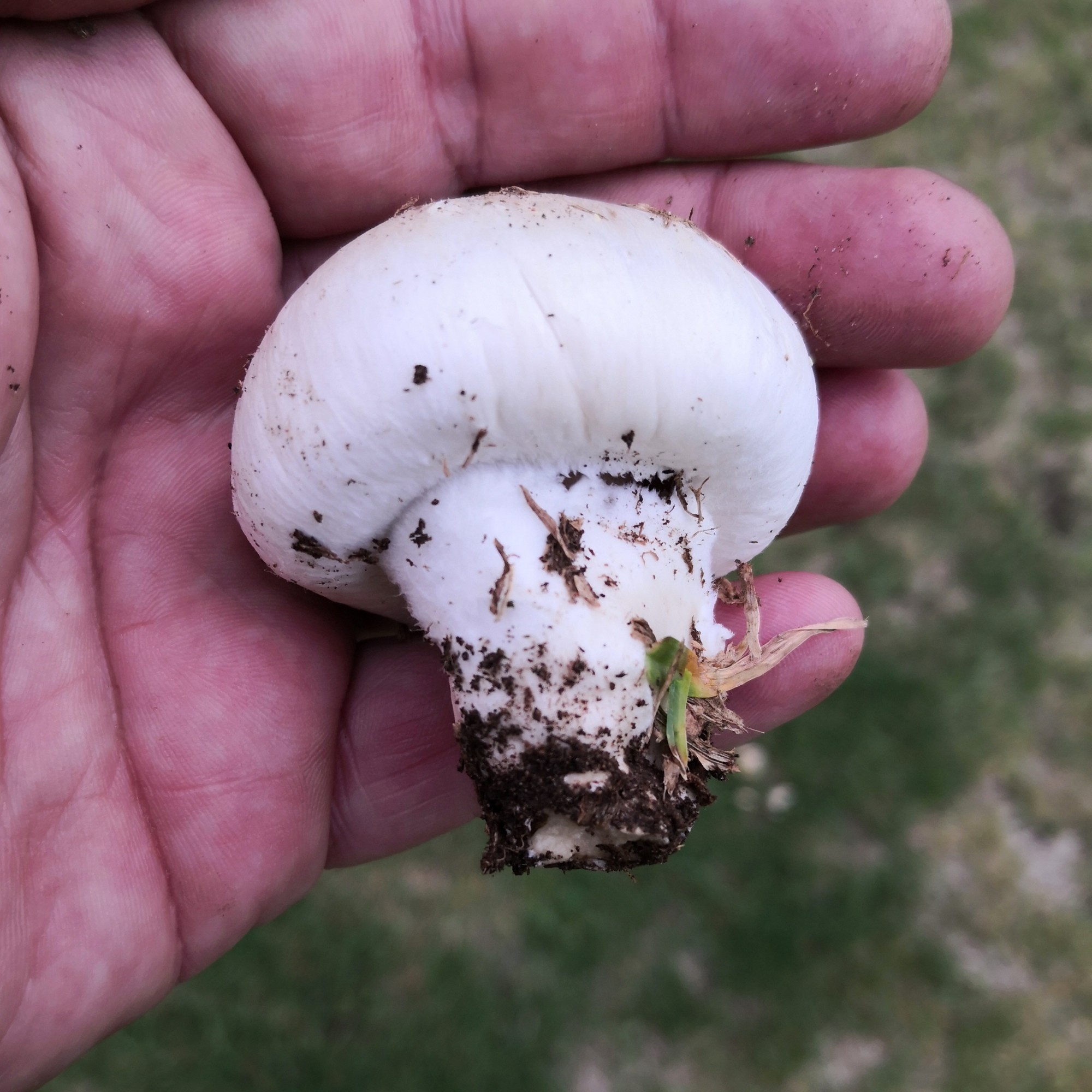
I was corrected recently by Pam from the State Herbarium, who told me that this species of Fungi is unlikely to be in the wild around Adelaide. I guess I was just lucky to find a patch that I could go back to for many years. That patch is gone now, buried under one of those little grey boxes that keep springing up what was once fertile agricultural land., kind of like mushrooms themselves. Supermarket mushrooms are cultivated varieties of Agaricus bisporus; it is a mushroom that has had a long association with our kitchens. So, in light of Pam’s sage advice, I present the Button Mushroom as a safe, easy to find in the supermarket, introductory species from which you can learn many of the fungal features that you can use when identifying your own finds.
Button Mushrooms are found on grass and lawns, especially when the area is well manured and someone has emptied an old mushroom kit from the big green shed out onto their garden. Firm, immature specimens are the best to eat. There are some look-alikes, especially the mildly toxic Yellow Stainer which is becoming more common. The last year or so, it seems that anything south of Evanston has turned out to be one of these nasties. Learning them is so important that I’ve dedicated a whole page to it, here.

Identifying Button Mushrooms (Agaricus bisporus) – a summary
- The cap starts hemispherical and flattens with age.
- The cap has firm white flesh that bruises light pink.
- Gills are crowded and free from the stem.
- Gills start off pink in immature specimens and become a dark brown as they age.
- Stem is solid and bruises a reddish brown. It has a thick, single ring.
- Odour is pleasantly ‘mushroomy’.
- Spore print is dark brown.


There are several similar wild mushrooms around Gawler. You can find out about them on our Agaricus species page.
