I get a lot of questions about herbs like ‘what’s in it’? or ‘how does it work’? So, I thought I’d do an occasional post that dives deeply into both of those questions. They’re not for everyone but if you’re not afraid of a little chemistry and physiology, dive on in with me!
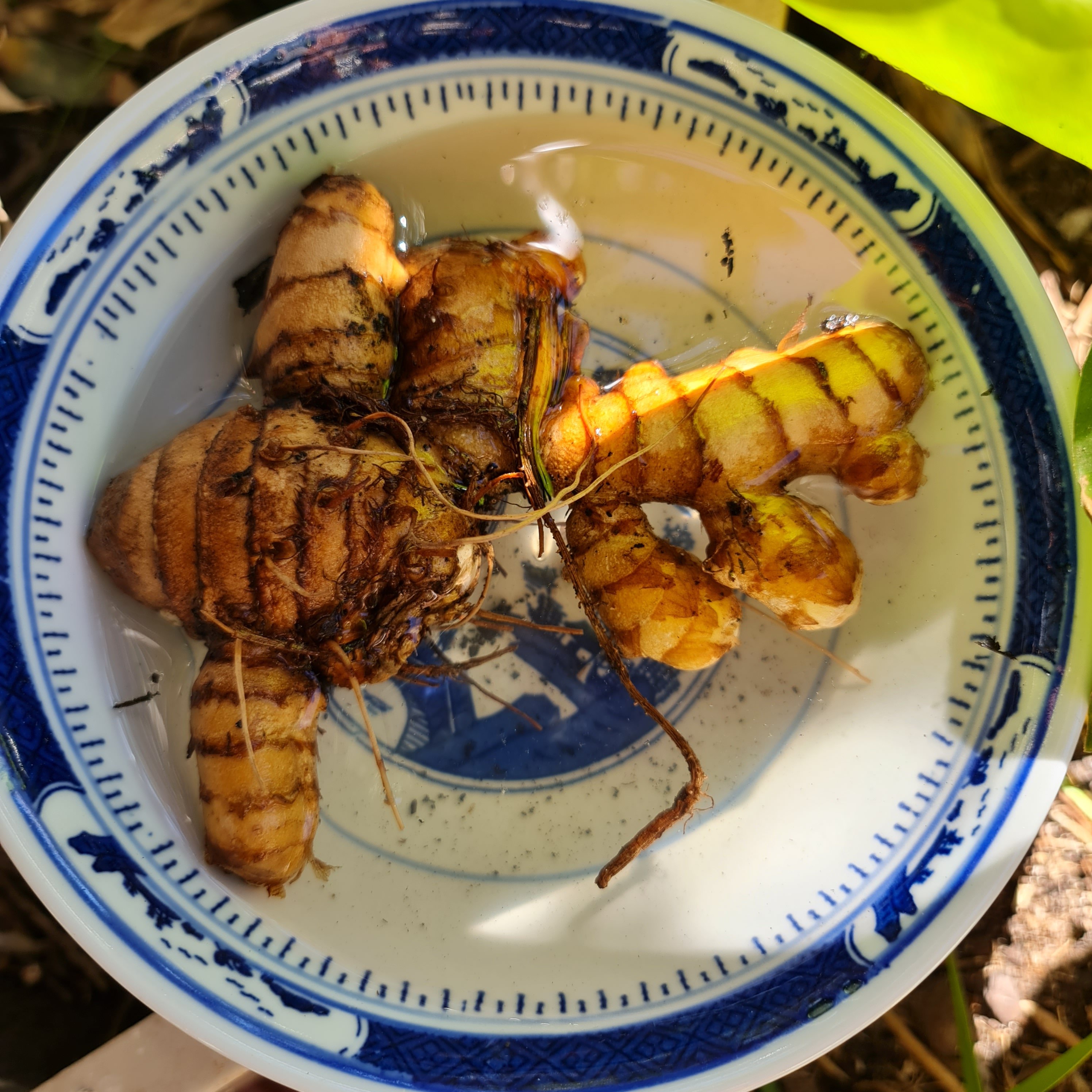
This first edition of ‘Danger: Chemistry!‘ is about the joys of that finger staining orange herb, Turmeric (Curcuma longa). There’s a lot of power in Turmeric, that much we’ve all heard. But did you know that using it in some ways lessens its effects but that there are ways to make it even more potent!
The key is to understand that curcumin—the primary bioactive constituent (for smarties, it’s a polyphenol) in Turmeric possesses potent anti-inflammatory and antioxidant properties but, when isolated as a single compound, as the medical industry is prone to doing, and presented, in its usual powdered form, unformulated curcumin has extremely poor bioavailability (under 1% can be absorbed by our body) due to a combination of fast liver and intestinal metabolism, poor water solubility, low absorption, and rapid elimination from the body. So why does it have such a great reputation and why do so many places sell it as a powder or in capsules?
To make Turmeric sing, we need to combine it with other things, called synergists. Luckily for us, these synergists are cheap and easy to obtain and simple to use.
The two main synergists are –
Black Pepper (Piper nigrum).
The synergist in Black pepper is an alkaloid called Piperine and, if you’ve read other pages in Ligaya Garden Online, or done a bit of other herbal reading, you will know that alkaloids have some very powerful effects on our body, mind and spirit. Piperine works powerfully through two complex sounding things that you can impress friends at parties with – Enzymatic & Glucuronidation Inhibition.
Normally, in the intestinal tract and liver, enzymes like UDP-glucuronosyltransferases quickly attach a substance called glucuronic acid to curcumin in a process called glucuronidation. This makes it water soluble and tells the body to flush it out via urine and bile. Piperine, the main alkaloid in black pepper, temporarily changes the permeability of the intestinal cell membranes, slowing the rate at which curcumin is metabolised (by UGTs and CYP3A4 we mentioned above) and allowing more of it through the gut wall before it is sent to the liver.
When curcumin is ingested, the body treats it as a foreign compound – foreign as in ‘not occurring in the body (aka ‘exogenous’), not something from overseas. It also works through the CYP3A4 enzyme and P‑gp transport pathway (more party people impressing material, but you don’t need to remember this is you’ve already dazzled folks with ‘glucuronidation’), which are two ways the body breaks down and converts (metabolises) and transports things to use or get rid of. These paths are important because they are also major pathways through which drugs, medications and herbal constituents are metabolised – it’s why Piperine can interact with your medicines! Turmeric also can affect medicines in different , often negative ways.
Together these two actions slows the enzymes that breakdown curcumin in the gut and liver, increasing and increase blood serum concentrations and bioavailability by up to 2,000% (that’s 20 X). Wow!
Dietary Fats & Oils (Lipids)
For more details on oils and the terminology associated with them, check out our Herb Infused Oil page.
Fats and oils (lipids) boost the uptake of curcumin which is highly lipophilic (fat loving, fat-soluble) and practically insoluble (hydrophobic) in the watery environment of the digestive tract. Fats doesn’t have to mean animal fats, they can include fish, cooking oils, nuts or seeds. in fact, an Avocado could count as a fatty meal in itself…maybe sprinkle it with fresh Turmeric and Black Pepper…yum! Without fats (lipids) , powdered forms of Turmeric clump together and pass through the gastrointestinal tract largely unabsorbed.
Taking curcumin with fats, whether in an oil or in a fat containing meal, stimulates the gallbladder to release bile salts and the pancreas to release lipases which emulsify (An emulsion is a mixture of two or more liquids that are normally don’t mix, such as oil and water, where one liquid is dispersed as tiny droplets within the other) dietary fats into tiny, floating, lipid droplets called micelles, which are bile-salt coated spheres that encapsulate hydrophobic curcumin molecules. Once encapsulated by the micelles, curcumin is absorbed across the intestinal cells and packaged into chylomicrons — tiny protein‑coated fat droplets that carry long‑chain fats and anything hitching a ride with them (like curcumin), into the lymphatic system. This pathway bypasses the hepatic portal vein and avoids immediate metabolism by the liver. Unsaturated fats (olive oil, avocado, fish oil) enhance this lymphatic transport, while medium‑chain triglycerides (MCT oil, coconut oil) provide rapid absorption by going straight to the liver.
An emulsion is a mixture of two or more liquids that are normally don’t mix, such as oil and water, where one liquid is dispersed as tiny droplets within the other.
Other things that act synergistically with Turmeric
Quercetin ( a flavonoid)
Flavonoids are cool, they’re the key antioxidants and healers in many herbs, so are worth getting to know a little more about. I’ll probably do a post about them one day but people always get more impressed by ‘sesquiterpene lactones’ which I don’t think are anywhere near as cool.
Quercetin is a flavonoid which is found abundantly in red onions, capers, apples, and green tea. Combining quercetin with curcumin extends the time that curcumin spends in circulation. It acts similarly to Piperine (covered above) by inhibiting enzymes such as sulfotransferase, and intestinal P-glycoprotein efflux pumps, which normally push curcumin back out of intestinal cells into the lumen (space) of the intestines, meaning that it doesn’t get absorbed.
Ginger (Gingerols & Shogaols)
A close relative of Turmeric, Ginger contains bioactive phenols (still not as cool as flavonoids) called gingerols and shogaols that stimulate gastric emptying and digestive enzyme activity. Ginger enhances gut blood flown (perfusion) and acts synergistically on COX-2 and inflammatory pathways alongside curcumin. Shogaols are present in higher amounts in dried Ginger, making it a better anti-inflammatory than their source, gingerols.
Combining Ginger with Turmeric has a two way benefit. The Ginger boosts the effectiveness of the Turmeric while the Turmeric boosts the anti-inflammatory properties of the Ginger. Win-Win!
EGCG (Green Tea Extract)
A compound in Green tea, called Epigallocatechin gallate (EGCG) works alongside curcumin down at a cellular level. It keeps it the curcumin stable for longer by protecting it from oxidation in watery environments, such as the gut. EGCG also strengthens curcumin’s effect by further dampening some of the major inflammatory signalling pathways such as NF-κB that tell tissues when to get inflamed and by how much.
Ar-Turmerone (in Turmeric Essential Oils)
Turmerones improve intestinal cell uptake of curcumin. Full-spectrum Turmeric extracts or whole-rhizome preparations usually perform better than isolated curcumin powder alone. Whole ground Turmeric root naturally contains aromatic turmerones (such as Ar-tumerone) along with curcuminoids while pure isolated curcumin lacks these oils. See further down this page for how to use Turmeric in its fresh form.
Eat it fresh
Fresh Turmeric contains a whole range of goodies beyond curcumin and some of those constituents help our body to use the curcumin more effectively while adding their own health boosting benefits. Eat it fresh!
If you’re finding this information useful, share it with your community
Does all of this mean I’m wasting my money on Turmeric powder?
Kind of. Piling capsules of plain curcumin into your body does little, especially if you’ve packed them yourself and packed as much as you physically can into the gel halves. This means that when they do make it all the way down, they end up as little rocks of the stuff and may break up on the way through.

If you take Turmeric as a powder without any of the synergists that we chatted about in the sections above, you will still get some benefit. As the powder works its way through your digestive tract, it will come into contact with and share some of its anti-inflammatory properties with cells in its lining and the biome that lives there.
Did you know that Curcumin is often prepared from fossil fuels? Yuck! Be careful of your sources…
Preparing Turmeric in the most effective ways.
As we’ve seen, Turmeric is a team player- one of a team of very potent herbs that has its powers boosted by them and in turn, boosts them. Mutual Aid at its best!
The synergists are common kitchen ingredients nowadays, and though they have a long history in colonialism and violence, they’re pretty well here to stay. Another thing that has come from colonised countries is Chai. I’m working on a booklet about making Chai to help improve the health of folks doing it tough in a manner that is easy and cheap. You can even liberate packages of spices from the big evil supermarkets for free – if you get what I mean… Don’t do this with small family owned businesses, they’re mostly struggling to keep their heads above water in this economic climate that is hurting us all.
We saw earlier that, possibly the best way to take Turmeric is in food where you’ve added a little Ginger and Black Pepper, and that have a mix of water and oil from cooking. This has all of the benefits. When paired with black pepper and consumed alongside regular dietary intake, curcumin is nearly fully absorbed. .
A common misconception regarding Turmeric is that it requires added fat or oil at the moment of brewing to be effective. While fat enhances systemic absorption, pure water-based Chai functions effectively through its own chemical extraction mechanisms and digestive synergy.
The traditional way to use these herbs is to make Golden Milk.
This is a combination of Turmeric, Ginger and Black Pepper and often Cinnamon (plus maybe a few other favourites) simmered in milk. Any kind of milk works, I use Oat or Almond but if dairy is your cup, then go for it. The fats in the milk (nuts are full of fats, so nut milks are too) extract the benefits from the spices and milk has a high water content which extracts the rest. Heating provides heat that helps the process along nicely.
Recipe: – this is a really basic remedy that will get you off the launchpad. Tweak any of it to taste and add anything else you think will help.
- 2 cups of milk of your choice
- 1 teaspoon of ground Turmeric,
- 1/4 teaspoon of ground Cinnamon,
- 1/4 teaspoon of ground Ginger, and a
- pinch of Black Pepper
Heat it up so that it’s simmering and keep it going for 5-10 minutes, stirring frequently.
Strain and sweeten to taste. Honey is best and because you’re not adding it at high heat, most of the goodness is added to your brew.
A useful tip is to cover your pot as much as you can while simmering so that as many of those gorgeous aromatics are captured.

Decocting fresh Turmeric
Fresh Turmeric excels when cooked or at least decocted. Boiling water breaks down the cellular walls, enabling the natural liberation of both water-soluble elements and quantities of plant lipids these naturally help a little of the curcumin get absorbed.
Use a ratio of about 5 cm of finely chopped or grated fresh rhizome to 1 cup of water. Bring to the boil, then reduce the heat and simmer (with the pot covered) for 5-10 minutes until the water turns a gorgeous golden colour.
Cool, strain and add to your other remedies.
Turmeric (Curcuma longa) contains a rich profile of active constituents beyond just curcumin:
- Water-Soluble Polysaccharides: Complex carbohydrates within the root easily which dissolve in hot water, delivering immune-modulating and gut-soothing benefits directly to the digestive tract.
- Volatile Essential Oils: Compounds such as turmerones, zingiberene, and phellandrene infuse into hot water, providing anti-inflammatory properties independent of lipid solubility. These volatile oils are small enough to bypass a lot of the digestive process, easily reaching the bloodstream intact where they can work their magic in the short time before they are metabolised by the liver.

Other herb pages on Ligaya Garden
We cover a lot of ground on many herb related topics here on our website. There are whole pages devoted to different topics as well as frequent posts. Some of the links are –