Common names: Cleavers, Stickyweed, Sticky Willy, Goosegrass, Velcro Plant, Clites, Cleaverwort
Taxonomic name: Galium aparine
Family: Rubiaceae
Related herbs: Madder, Coffee
Area of origin: Europe, North Africa, Asia
Parts used: aerial parts, seeds
Can be used medicinally for: eruptive skin conditions, dry skin conditions (psoriasis) inflammation, ulcers, pimples, fevers (especially intermittent), constipation, hardening, lumps, cysts, lymphangitis, urinary tract infections, urinary stones, gravel cystitis, painful (scalding)/dripping urination, water retention, swollen glands, adenoids, fresh wounds, skin blemishes, sunburn, prostate irritation, liver congestion, hepatitis
Healing Actions: alterative, anti-inflammatory, antipyretic, antispasmodic, depurative, demulcent, urinary demulcent, urinary demulcent, anti-dyscratic, diuretic, diaphoretic, lymph tonic, hypotensive, hemostat, litholytic, emmenagogue, immunostimulant, tonic, refrigerant, detoxicant, laxative, resolvent, lymphatic, lymph detoxifier
Taste: sweet, bitter, salty
Tissue states: heat/excitation, atrophy, congestion, dampness
Energetics: cooling, drying, dissolving
Organ/System affinities: liver, bladder, prostate, blood, fluids, lymphatics, skin. Kidney, Bladder
Healing constituents: acids (caffeic, p-coumaric, gallic, p-hydroxybenzoic, salicylic, citric), coumarins, iridoids (asperuloside, rubichloric acid), tannins, anthraquinones (galiosin), chlorophyll, trace minerals
Contraindications and warnings: Contact with the skin can cause a rash in susceptible people. As Cleavers is an emmenagogue, it should be avoided during pregnancy.
James Duke recommends that diabetics use the expressed juice of Cleavers with caution.
Drug/herb interactions:
Description
Once you’ve encountered Cleavers (Galium aparine), you’ll find it impossible to forget. It is a rambling, spreading, climbing plant that is covered in tiny, hooked hairs. These hairs give rise to most of its common names – Velcro Plant, Sticky Willy, Sticky Weed. It’s most frequently used common name ‘Cleavers’ comes from ‘cleave’ which, in addition to meaning to cut, also means ‘to adhere firmly to or with something’.
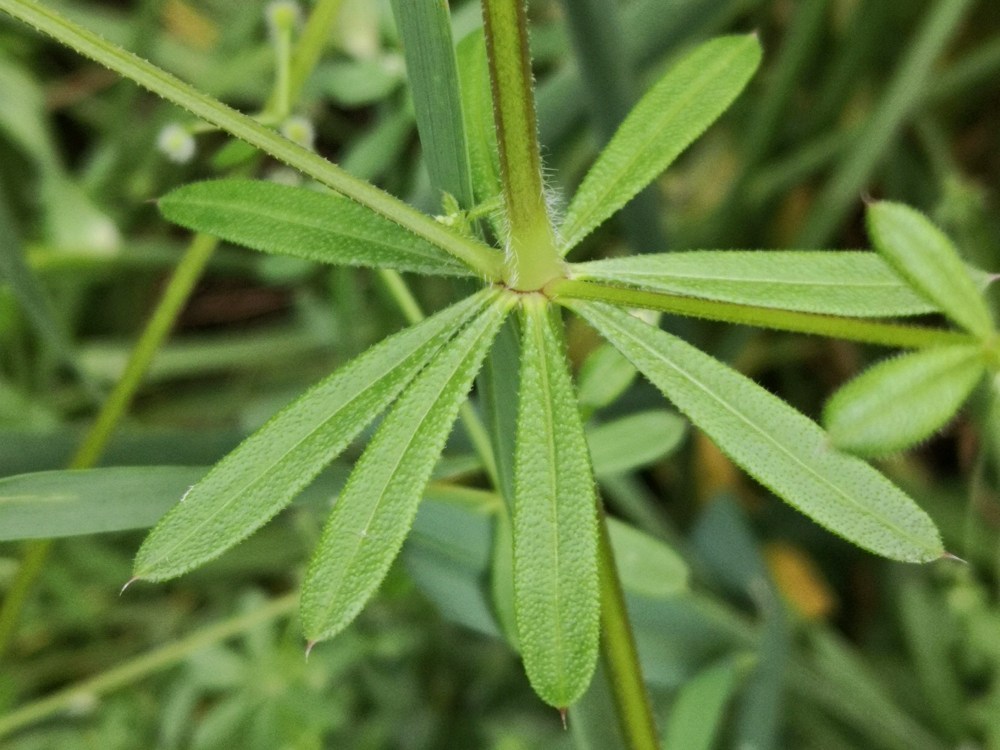
Cleavers is an annual straggling plant with angular or square stems that grow along the ground or climb up over other plants.
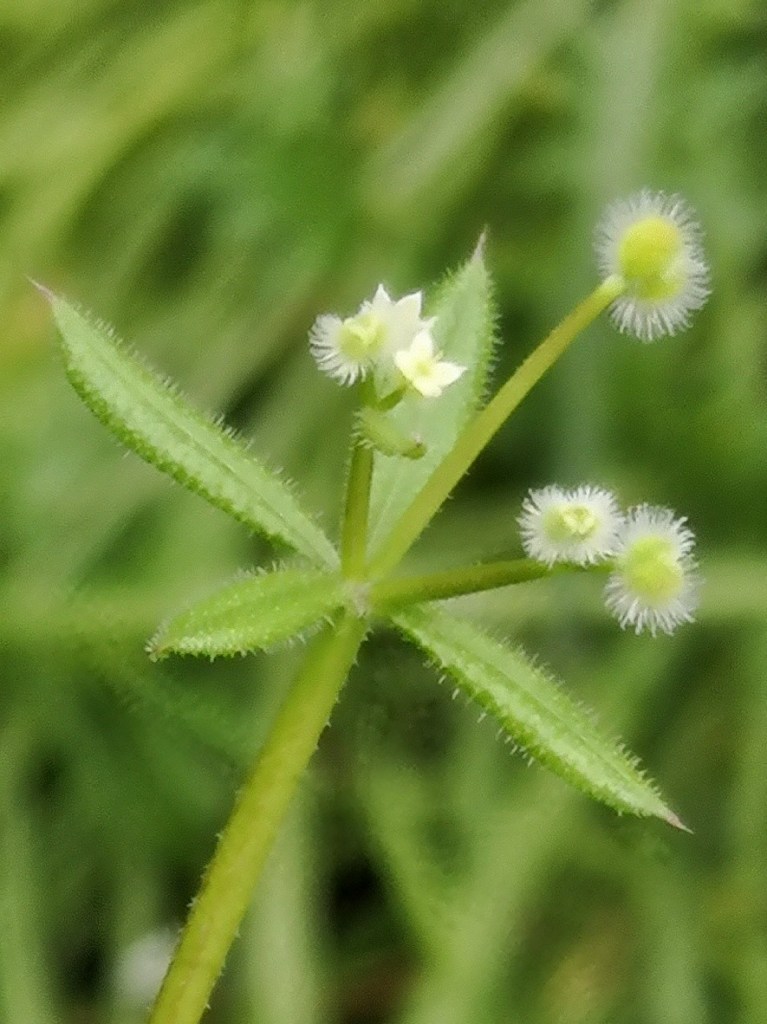
Leaves are long and narrow and radiate out from the stem in whorls of 6 – 8 and have a distinctive furrow in the middle and a small point at the tip. It has tiny white flowers with 4 petals and whorls of lanceolate leaves that number 6 to 8. The whole plant is covered with short, hooked hairs that help it climb.


Cleavers can possibly be confused with some of the Bedstraws that are in the Galium family as well. The differences with Cleavers and the local Bedstraw are – Bedstraw isn’t covered in sticking hairs like Cleavers. Our Bedstraws are much smaller (see the pic below) and last, the number of leaves in the whorl.

Medicinal uses
In ancient times, the matted stems, covered with tiny hairs have been used as a sieve, a practice of the ancient Greeks who used it to strain their milk,
If you harvest the plant while it is very young and before the hairs get too strong, you can boil Cleavers and eat it as a green vegetable. Geese, traditionally, are very fond of this plant, giving rise to another common name ‘Goosegrass’. As with a related plant, Coffee, which is also in the Rubiaceae (Madder) family, the fruits can be roasted and used as a low caffeine coffee substitute.
As a healing herb, Cleavers is used in many of the ways that Chickweed can be used. Cleavers appears in this area much later than when Chickweed shows itself, extending into early Summer, by which time Chickweed has dried up and vanished for the year. All of the broad range of healing abilities of Cleavers really boil down to three actions – it cools irritation and softens hardened tissue while moving away all of the wastes via body fluids.
Moving fluid (outwards) helps create sweating and relieves fever plus also helps clean skin. Cleaver’s saltiness (in the herbal sense) draws moisture toward dry, atrophic tissue, even when it has hardened. Moving lymph drains, cools and softens. With a little thought, you can understand how Cleavers does its good work by applying these three actions.
Cleavers is a well known and potent diuretic, so is of use in cases of fluid retention, heart conditions where fluid is a problem, urinary tract and kidney problems and bad breath (when it is caused by poor elimination of wastes due to a lack of urination). It can stimulate the liver too, metabolising the waste products delivered there in the lymph via the portal vein.
Cleavers also is a lymphatic tonic. It gets our lymphatic fluids moving, much in the same way that Chickweed does. Lymph contains many immune compounds and carries them around the body where they are ready to fight invaders. It picks up cellular wastes and the wastes leftover from immune cells fighting invaders and moves those wastes to the main organs of elimination from where it can be moved out of our bodies. This makes Cleavers and Chickweed perfect or recovering from long term illness or poor lifestyle choices. In any case of infection or inflammation where the body has been fighting invaders and there is a lot of waste built up in the form of dead cells and bacteria and other by-products of our immune system.
By cooling tissues and moving lymph, then stimulating or supporting our organs of elimination, Clevers makes almost the perfect Spring tonic plant all by itself!
Preparing and using Cleavers
Cleavers is best used fresh when it can be pressed or juiced as a succuss. It can be drunk as an infusion or used as a poultice to cool and soothe external issues such as rashes burns.
You can combine it with other herbs in an infused oil in order to make a salve or ointment. It works beautifully with Calendula, Chickweed, Plantain or even Elder Leaves as a salve for wounds and inflammations.
If you’re finding this information useful, share it with your community
Other herb pages on Ligaya Garden
We cover a lot of ground on many herb related topics here on our website. There are whole pages devoted to different topics as well as frequent posts. Some of the links are –