Common names: Common Sow Thistle, Smooth Sow Thistle, Annual Sow Thistle
Taxonomic name: Sonchus oleraceus
Family: Asteraceae
Related herbs: Dandelion, Catsear, Perennial Sow Thistle (S. aver), Rough Sow Thistle (S. asper)
Area of origin: Europe, Western Asia
Parts used: Aerial parts, roots
Can be used medicinally for: cardiovascular health, eyesight, menstrual issues, abortions, poor digestion, inflammations, swellings, congestion, constipation, diarrhea, fevers, opium addiction, sleep problems, worms,
Healing Actions: diuretic, hepatic, sedative, stomachic, abortifacient, emmenagogue, cathartic, purgative, hydrogogue, febrifuge, vermifuge, liver tonic, neuroprotective,
Taste: bitter
Energetics: cooling, drying, stimulating, draining
Tissue states: heat/excitation, damp/damp heat, dry/atrophy
Organ/System affinities: liver, kidneys, digestive system, Liver Gallbladder
Healing constituents: vitamins A, C, and K, flavones (inc. apigenin), flavonols (inc. quercetin, kaempferol), phenolic acids (inc. caftaric acid, chicoric acid, chlorogenic acid, gallic acid), triterpenoids (inc. lupeol, alpha-amyrin, beta-amyrin, ursolic acid, oleanolic acid, and betulinic acid,), volatile compounds (inc. n-nonadecane, trans-caryophyllene, and methyl dihydrojasmonate), tannins, protein, carbohydrates, sesquiterpenes, coumarins (inc. coumarin)
Contraindications and warnings: The plant is emmenagogue and the roots have also been used as an abortifacient – two reasons why this is a plant not to be used during pregnancy!
Drug/herb interactions:
If you’re finding this information useful, share it with your community
Description
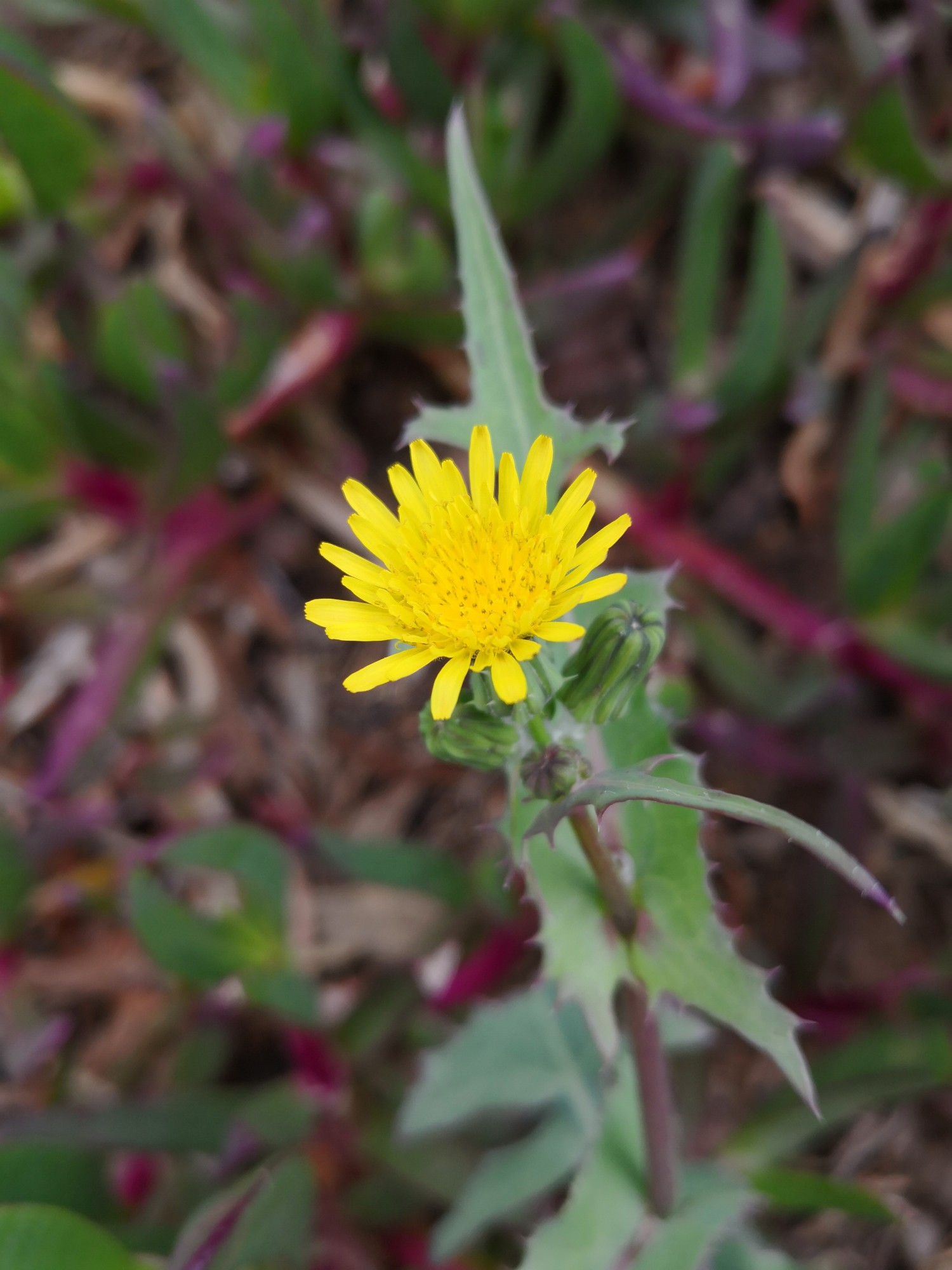
Sow Thistle (Sonchus oleraceus) the most common Thistle growing around Gawler. It is usually an annual here but can be a biennial in some areas. It comes out in late spring and lasts until early Winter, although some are seeing the whole year through nowadays). It grows to about 1.5 metres tall in this area, though I’ve heard of it being much taller in others.
The leaves of a Sow Thistle clasp around the stem at their base and often have wavy or deeply toothed margins. They form a basal rosette, then alternate up the stem. Stems are hollow. The lower stems are usually smooth and become ridged as you work your way up the plant. Colour varies from green, through red/burgundy green in patches to completely burgundy.
Breaking a stem yields a bitter, white latex,
Yellow Sonchus flowers are composite (the old name for the Asteraceae family was Compositae, which I find more descriptive) and have only ray florets in their flowers. Flowers often start to close in the afternoon.
They are very similar to Dandelion flowers but grow on multiple stems (Dandelion usually only has one flowering stem). Sow Thistle can be differentiated from Catsear, which has similar flowers but the stems are much thicker and angular whereas Catsear are thinner and wiry.
Flower heads are Dandelion like and the seeds, tiny and flat with a little parachute that is characteristic of Asteraceae.

Catsear and Dandelion are both included in this blog if you want to make a comparison.
Sow Thistles are a lure plant for Aphids, so watch out when you harvest them, you may get a little more than you bargained for!

Medicinal use
Animals know the value of Sow Thistle. If you’ve got birds or animals, they will go crazy over the stuff and often eat it in preference to anything else.
Taken internally, this bitter herb boosts liver and gallbladder function, increasing energy through improved digestion of the rest of the nutrients in the plant. That improved digestion helps us digest and absorb the nutrients in Sow Thistle such as Vitamin C and many minerals, especially Calcium, Phosphorus and Iron. It also has vitamins A, B1 and B2.
Juice from the stem is a hydragogue (a purgative type of remedy that causes watery evacuation of your bowels). It’s also a cathartic, which means it causes a ‘strong release’ of both bowels, stomach and emotions. It should be used with great caution since it can cause colic and tenesmus. They have hepatic and stomachic properties that help with many digestive ailments as well as being a tonic for digestion. Interestingly, Sow Thistle is listed here and there as having been used for cases of diarrhea. It just goes to show how a plant can work out what’s best for us!
Like other Thistles, Sow Thistle has a bitter, white sap. This sap has been used topically for warts, liver spots and skin blemishes. , This latex has been used to treat warts and cancer, and has been used as a chewing gum by the Maori in New Zealand.
The sap, like that of many related plants, is a ‘soporific’ – that is, it helps us sleep. The sleep that comes after ingesting one of the Lettuce family is a gentle one without the side effects of pharmaceuticals. That’s one of the reasons that it has also been used in the treatment of Opium addiction.
The plant is emmenagogue and an infusion has been used to bring on a tardy menstruation. The roots have also been used as an abortifacient, so this is a plant not to be used in pregnancy!
A traditional infusion of the leaves and roots has been used as a febrifuge and tonic while the roots alone are , depending on their method preparation, I guess, edible, purgative and have been taken as a vermifuge to expel parasites of the wormy kind.
Sow Thistle flowers are edible and like other plants in the Aster family, such as Dandelions , contain luteolin, a powerful flavonoid that benefits a range of things in our body from our circulatory system to our brain and eyes. It can help as an antioxidant, help with macular degeneration by accumulating on the macular disc, reduce inflammation of many kinds and help reduce oxidative damage.
Preparing and using Sow Thistle
The whole plant is edible, all parts can be eaten cooked or raw, but pick the youngest, freshest parts because Sow Thistle gets more bitter with age. Young roots are palatable but caution should be taken because of possible herbal; effects that may not be wanted (see above).
Apply the sap directly to warts, liver spots and skin blemishes
An infusion or decoction are the traditional ways to take Sow Thistle. It is the best way to get all of its effects for your stomach, bowels and liver and the best way to benefit from its sleep inducing (soporific) nature.
Other herb pages on Ligaya Garden
We cover a lot of ground on many herb related topics here on our website. There are whole pages devoted to different topics as well as frequent posts. Some of the links are –