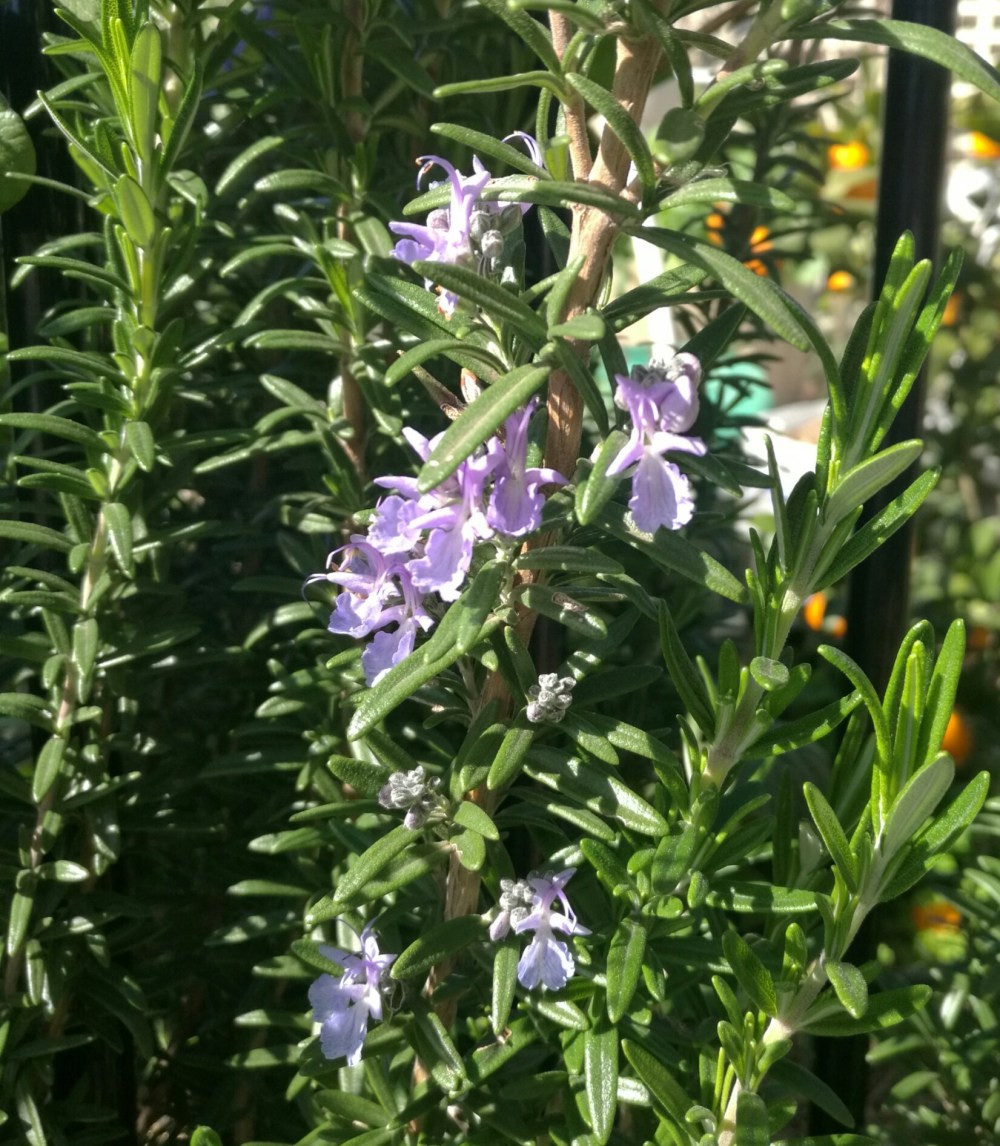
Common names: Rosemary
Taxonomic name: Salvia rosmarinus (it used to be Rosmarinus officinalis until 2017 so you’ll still see that in older books).
Family: Lamiaceae
Related herbs:
Area of origin: Mediterranean
Parts used: leaves, flowers
Can be used for: Nervous problems, circulatory problems, giddiness, digestive issues, blood sugar problems.
Actions: tonic, nervine, vulnery, astringent, diuretic, expectorant, circulatory stimulant, rubefacient
Taste: pungent, warm, dry, astringent
Tissue states: atrophy, depression
Energetics: stimulating, warming, upwards
Healing constituents: volatile oils, flavonoids, tannins, phenols, acids ( rosmarinic acid, betulinic acid camphor, caffeic acid. carnosic acid , ursolic acid,) terpenoid bitters, proanthocyanidins, carnosol
Warnings: None
Description
A herb well known in tradition and in the kitchen, Rosemary has been a staple in the West for millennia. It was well loved by the Ancient Greeks, and is just as well known today.
The taxonomic name, Rosmarinus means, literally, ‘Rose of the sea ‘ and alludes to the way it overcomes the harsh conditions on the coast where it was originally found. In 2017, it was decided to move it into the genus Salvia that contains Sage. It’ll still be found under its old name in books published before that time and in blogs that have forgotten to update it until today…hmmmm…
Rosemary is a member of the Mint family (Lamiaceae), though not sharing the growth pattern and love of moisture that is shown by the true Mints. Rather, its membership to that family comes from the anatomical features of its flowers – that’s how most taxonomic choices have historically been made. While it responds quickly and vigorously to watering, plants are quite drought tolerant as are many of the herbs in this family. What it does share with Mints is its aromatic nature? Rosemary oils are some of the most widely used in the world.
Rosemary is drought tolerant evergreen shrub to about 1.5m. Dense, foliage of short leaves, broad on top and white and slightly furry below. Flowers are purple and lipped (as is characteristic of this family) and can appear several times a year. New growth is always to the end of the stems, so lower parts and the inside of the bush can get very woody and straggly. Regrows strongly after trimming.
Medicinal use
So how is using Rosemary herbally good for us? Good question.
There are two areas where Rosemary predominantly works. One is the nervous system and through that, muscles and circulation. The other area of effect is the blood, particularly, it’s effect on the body’s use of blood sugars.
I like to think of Rosemary and Lavender as being on a continuum. Rosemary lifts energy and stimulates while Lavender soothes and sends downwards. I find that this is best seen in headaches. I use Rosemary when one’s mind is heavy and dull and there’s that dull headache that comes with extreme tiredness. Rosemary sends blood and energy upwards, stimulating the brain and blood vessels and clearing the feeling. Lavender is great for the opposite kind of headache, one caused by anxiety or overthinking, the kind that comes when the brain is racing and one’s head is full of thoughts. Lavender brings that energy downwards and clears the head that way.
Rosemary has a strong effect on our nervous systems, it stimulates the parasympathetic nervous system, especially the voluntary, smooth muscles of our hollow organs such as heart, gall bladder and arteries ( I tend to think of arteries as an organ in themselves – science has discovered that they are far more complex and important than being merely pathways for oxygenated blood that most of us were taught about in school). At the same time, Rosemary calms the sympathetic, voluntary nervous system and muscles.
This dual effect makes Rosemary ideal for blood pressure and other circulatory problems caused by stress. Rosemary sends blood to the head, making it is useful for giddiness caused by rapid rising, though if you suffer from Postural Orthostatic Tachycardia Syndrome (POTS) it only helps a little. POTS is a condition where your blood pressure drops a lot when you change position, such as by standing up. It doesn’t even have to be standing quickly, just rising from a sitting position can trigger it. POTS isn’t just the usual dizziness that you get from standing too quickly, it is is full on vertigo, limb weakness, shaking and heart palpitations. It’s yucky and I have it. Taking some Rosemary tincture throughout the day can minimise , but not relieve the effects.
Through its effect on circulation by its stimulation of arteries, Rosemary can stimulate blood flow and clear areas of congestion and stagnation. It is traditionally used externally to increase local blood flow (that’s called rubefacient) to areas and relieve pain through clearing congestion and inflammation.
Rosemary can help with blood glucose problems as it helps the body to use glucose once it is in the bloodstream. It aids thinking and memory by Increasing blood flow and helping the liver and brain metabolise sugars – that’s how it gets its reputation as the ‘memory herb’. Lavender complements Rosemary in its effect on blood sugar. Lavender improves the conversion of sugar stored in the liver into glucose, giving rise to more energy. Rosemary has an effect more like insulin, reducing blood sugar levels when they are too high.
This great kitchen herb helps the digestion by stimulating the gallbladder to produce bile, then it aids the liver by helping it burn sugars, then it also helps the stomach and intestines to move food through. Is it any wonder that Rosemary is a favoured herb in so many kitchens-it’s almost the perfect digestive!

Preparing and using Rosemary
The simplest way to enjoy some of the benefits of Rosemary is to crush up some leaves and flowers and take a deep sniff. The wonderful aroma will hit your system and the good things will start to happen. It’s a good way to improve your memory without endless cups of Rosemary tea.
Teas, of course are a great way to take any aromatic plant but remember to keep the pot or cup covered to retain the volatile oils). It is quite a strong herb, so as little as a teaspoon per cup of the herb (fresh or dried) can be enough for some. Infusions work well but use slightly less than the recommended amount as the taste can be overpowering when well steeped.
Rosemary takes well to tincturing. I tincture it at high concentrations (70%+) to extract those lovely aromatic constituents. Don’t double extract and add the watery liquid to the tincture – a lot of oily material will precipitate and you will have lost a lot of the aromatic principles in the goo. You can actually use the goo by giving your bottle a hard shake before dispensing, that will get a lot of the oils back into suspension (not into solution though). See the post ‘What’s this goo in my tincture‘? for more info about this phenomenon.
Prepare a Rosemary infusion to wash wounds or as a fomentation (hot compress) to ease pain and increase local circulation.
Of course, the part of Rosemary that is most famous is the essential oil. It smells heavenly and can be diluted and applied as you would any Rosemary preparation, diffused to clear sinus congestion and respiratory illness or added to other herbal oils.
Some folks like to make Rosemary salt. Combine 2 parts salt to 1 part fresh Rosemary and mix well. Store in a jar somewhere warm for a few days. Then lay the mix out on some cloth somewhere not too hot but quite airy. Leave this to cure until dry. Store and use at your leisure.
Other herb pages on Ligaya Garden
We cover a lot of ground on many herb related topics here on our website. There are whole pages devoted to different topics as well as frequent posts. Some of the links are –