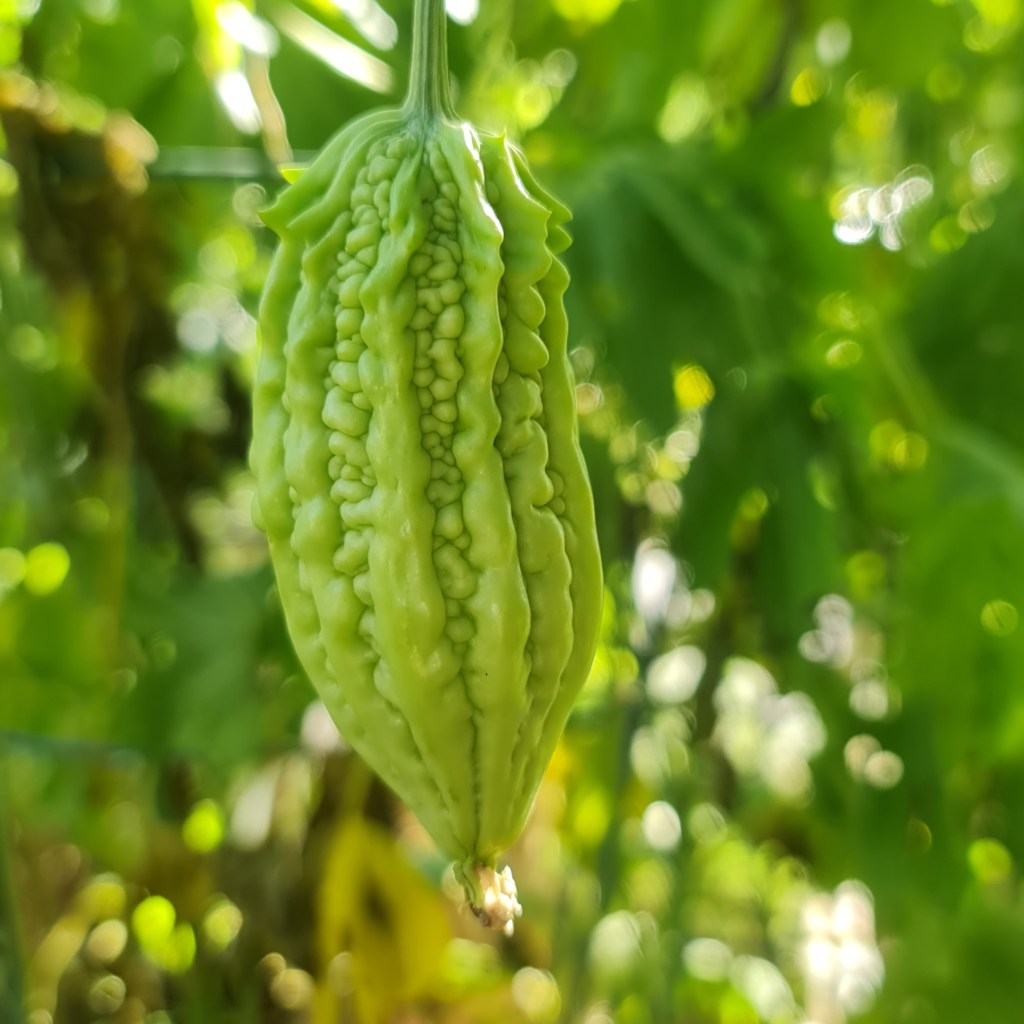
Common names: Bitter Melon, Bitter Gourd, Ampalaya, Alligator Pear, Liang gua, Ku gua, Ampalaya, Karela
Taxonomic name: Momordica charantia
Family: Cucurbitaceae
Related Herbs: Melons, Squash
Area of origin: Africa
Parts used: Fruit, leaves, tendrils
Can be used for: some cancers, high blood sugar, fever, HIV and AIDS,, infections, muscle soreness
Actions: digestive, diuretic, emmenagogue, immunomodulating, stomachic, emetic, laxative,
Taste: bitter, pungent
Tissue states: tension, cold, depression
Organ/system: Liver, Gallbladder
Meridians: Heart, Lung, Spleen, Liver
Energetics: cooling, stimulating, dispersing
Healing constituents: Quinine, charantin, polypeptide-P, protease inhibitors, calcium, magnesium, potassium, iron and zinc, Vitamins C and A, fibre, folate (B9)
Warnings: Bitter Melon has been used as an abortifacient, so avoid it if you’re pregnant. It also interferes with some placenta cell development (syncytial cells). Heavy use can cause gastric upset.
Description
Here at Ligaya Garden, we call Bitter Melon by its Filipino name, ‘Ampalaya’. It is a quick-growing, dense vine used as a strategic shade around the garden. It loves to climb, so keeping it up on a trellis is a wonderful way to increase your gardening space by taking advantage of the fact that the fruit likes to hang.
Amplaya is one of the Melon family (Cucurbitaceae), and there are two varieties – The Chinese variety is long, green, and covered with wart-like bumps on the rind. Plants can also put out a very pale green, almost white fruit. The Indian variety is longer and has more pointed ends. This variety has more jagged (though not sharp) spikes than the Chinese variety’s bumps. In both cases, it seems best to use the fruit before maturity.
The seeds of Ampalaya have a red, sweet gel around them that can be removed by sucking them.


Medicinal use
The bitterness that gives Bitter Melon its name is the key to its herbal use in digestive and metabolic issues. Ampalaya is such a potent stimulant to our central nervous and immune systems that, in the Philippines, traditional midwives place an Ampalaya leaf in the mouth of newborns to kick off a strong immune system.
Ampalaya also supports our body in general by being full of mineral nutrients, vitamins A and C and having a high level of fibre. It also contains folate (vitamin B9), which helps form red blood cells. Ampalaya is truly a boost to our immune system!
Water-soluble extracts of bitter melon have led to significant decreases in levels of the LDL (bad) form of cholesterol in patients. The key to this must be the bitterness moving the liver and gallbladder to work better or harder. They are the key organs that work with fats and oils and can, along with the high fibre content, contribute to the laxative properties of Ampalaya.
In TCM, Bitter Melon seeds can be dried and roasted, ground and used as a stimulating tonic for fatigue and sexual dysfunction, which are linked in so many ways in most schools of herbalism.
The juice of Bitter Melon is used in many traditions where it is cooling, dispersing energy applied directly to the skin relieves soreness and redness and is particularly effective in reducing the severity of psoriasis eruptions. It contains a compound that improves the turnover rate of the production of new cells (by inhibiting the enzyme guanylate cyclase if you want to get technical). If you’ve spent a little time on this site, at my workshops and around herbalism in general, you will know the relationship between digestion and elimination (especially the liver) and skin conditions.

Amazing Ampalaya has also been successfully tested as a possible treatment for some cancers, particularly the stomach, colon, lung, and upper respiratory tract.
The most famous use of Ampalaya in its use in cases of diabetes, especially Type 2. Bitter Melon affects the metabolism of sugar and its uptake by cells in several ways, making it a multi-pronged tool in the herbal treatment of this disorder.
Bitter melon works in many ways to aid diabetics. First, it reduces the response of the nervous system to sweet tastes. It has been found to reduce after-meal glucose levels in the blood. It improves how sugar is used by cells and can facilitate greater uptake by them because the active compound, charantin, keeps sugar in solution in the blood longer, helps cells pick up sugar, and sensitizes them to its sweet taste. You may have noted in a previous sentence that Ampalaya reduces the central nervous system’s response to sweet tastes, but here, we see that it improves the cell’s response to it. Multi-layered healing, indeed!
Ampalaya can improve insulin tolerance without increasing insulin levels in type 2 diabetics. It can also stimulate the pancreatic cells that make insulin. It also has its own version of the compound – a chemical named ‘polypeptide-P’, which can also help regulate blood sugar in diabetics. Bitter melon helps diabetics in so many ways, each as needed for the individuals health.

Preparing and using Bitter Melon
We use Ampalaya in many ways at our place. Jelina cooks it for use as a vegetable in meals. The bitter taste can be almost removed by covering pieces in salt, in the same way one does with Eggplants. Though bitterness is the main taste characteristic, I wouldn’t do too much of this. Like other melons, the tendrils, vine tips and flowers can be cooked as vegetables.

The gel around the fresh seeds makes a cooling snack, just keep it in your mouth and suck it off of the hard seed.
The plant juice seems to be the most powerful way to take Ampalaya for medicinal reasons. Tests with powdered extracts proved ineffective in some clinical trials. We juice the fruit and leaves and make an herbal juice (succus) for later use. The seeds can be dried, roasted and ground for another remedy. You can also slice and dry the fruit for later use, though drying drastically reduces the bitterness.
Some folks with upper GI issues can still benefit from Bitter Melon by taking the dried, powdered fruit is capsules.
I make a tincture from the fresh leaves for use later in the year. A weight to volume tincture at 1 part herb to 2 parts alcohol (60%+ ABV) extracts a bitter, oily substance that makes a foul-tasting tincture that we have used to quickly drop the blood sugar levels and symptoms in families who have type 2 diabetes. I’m also experimenting with a tincture of the fresh fruit. I make a folk tincture using a high alcohol concentration of 85% for this because there is so much moisture in the fruit. This year also, I’m trying macerating the ripe fruit in rubbing alcohol to try it out as a muscle relaxant – another reported benefit of Ampalaya.
Other herb pages on Ligaya Garden
We cover a lot of ground on many herb related topics here on our website. There are whole pages devoted to different topics as well as frequent posts. Some of the links are –