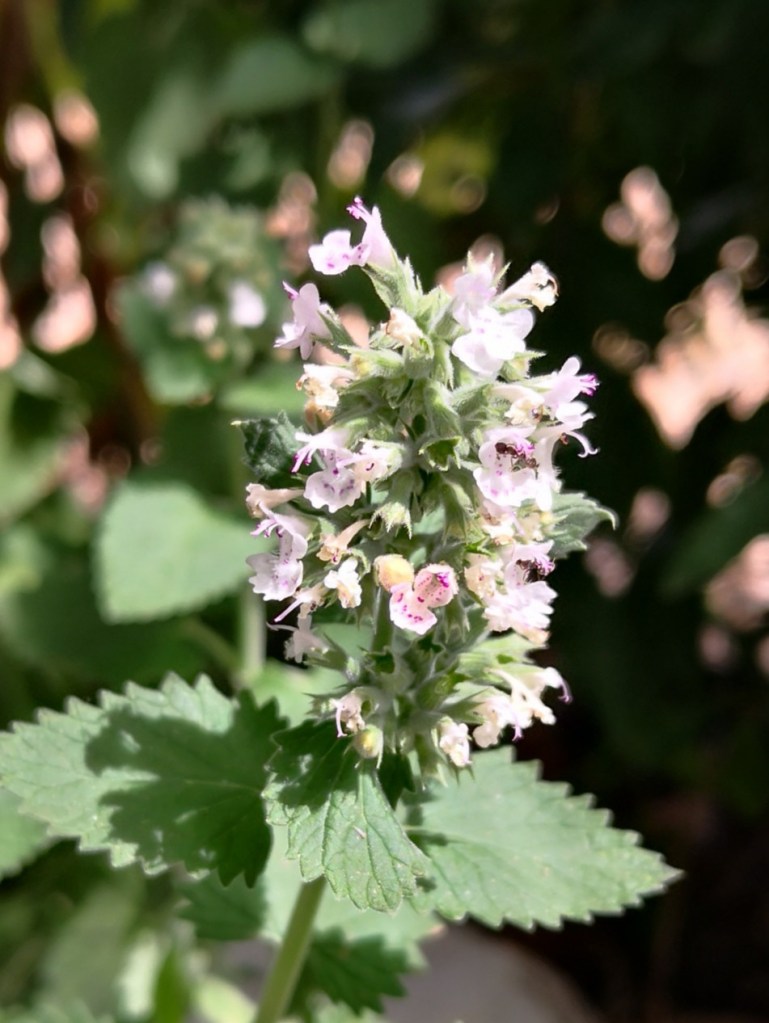
Common names: Catnip, Catmint, Catwort, Mao Bo He
Taxonomic name: Nepeta cataria
Family: Lamiaceae
Related herbs: Mints, Lavender, Rosemary, Oregano
Area of origin: Eurasia
Parts used: leaves, flowers
Can be used for: relaxant, fevers, colds and flu with headaches, migraine, anxiety, emmenagogue, cramps, bloating, colic, antacid, diarrhoea, dermatitis, toothache, cats love it, insect repellent attracts Lacewings
Organ/System affinities: Stomach, Lungs, uterus, skin
Healing Actions: anodyne, diaphoretic, febrifuge, refrigerant diuretic, soporific, relaxing nervine, sedative, antimicrobial, sweetens milk during lactation, carminative, reduces HCl production
Taste: acrid, pungent
Tissue states: excitation, wind/heat, constriction, depression
Energetics: warming, stimulating, cooling
Healing constituents: aromatic oils (carvacrol, thymol), nepetalactone isomers, iridodial, valepotriates
Warnings: Some folk find that Catnip has a depressive effect on them. Some may suffer stomach upset or allergies after taking Catnip. Don’t use the roots, chewing on them is supposed to make people irritable and cranky.
Description

Catnip is one of the Mint Family, Lamiaceae. You’ll note when looking at it that it has the square stem and lipped flowers characteristic of that Family. In Catnip’s case, the flowers are white with purple spots and grow from flowering spikes. It is a grey-green perennial with pleasantly downy, toothed leaves. It has a pleasant smell that is pretty characteristic.
Before we start looking at Catnip, I should note that even though one of its common names is ‘Catmint’, the Catmint that is sold in garden centres can be any of a few varieties of related Nepeta that have far weaker medicinal qualities and are grown for landscaping. Make sure that the one you but is clearly labelled Nepeta cataria.
Medicinal uses
Like other members of the Lamiaceae Family, Catnip has an essential oil as its therapeutic component. The leaves are the most used part but the flowers and stem work their way in there too. Don’t use the roots though, they have been found in the past to make even the most placid person irritable and cranky. Lesley Gordon refers to a story about a hangman who couldn’t face his work until he had chewed Catnip root.
A cup of Catnip tea before bed time is a sure way to ease yourself into a restful sleep. You could try one or two at other times of the day to relax you in general. It is my second favourite relaxant, after Hops (Humulus lupulus). Its sedative properties seem to come from its essential oils and valepotriates, similar to those found in Valerian.
Like several other Mints (Peppermint and Lemon Balm), Catnip is a general first aid herb for children. It is indicated for the quiet ones who internalise things too much (I wish Mum had some of that when I was a kid).
Catnip is also useful in cases of colds and flu. It can help kick up a sweat and speed along the healing process, One of my favourite cold remedies is a tea of Catnip and Elderflower or Yarrow, especially if I need to sleep. All these herbs complement each other quite well, though I advise adding a little honey to lighten the taste.
Matthew woods points out that Catnip reduces HCl production in the stomach, relieving an acid tummy, something that is sometimes caused by anxiety. It also lessens the jitters one may get from too much coffee (can there be such a thing)?
As with other Mints, when the essential oil in Catnip contacts the lining of the gut, its warming character relaxes the smooth muscles, resulting in an easing of cramping, colic and nausea. Catnip is especially called for when one gets butterflies or nausea caused by anxiety because of its two-pronged ability to relax the mind and the stomach at the same time. It is indicated for diarrhoea too, especially of the nervous kind but to make you even more nervous, the best way to take it for this problem is as an enema. Yuck!
Chewing on Catnip can, like Yarrow, ease toothache and the antimicrobial properties of the oils can help you get a handle on infections.
Nepetalactone is the chemical that gives Catnip its well known effect on cats. It is also an insect repellent against mosquitoes and cockroaches. Interestingly, another compound in the oil, iridodial attracts Lacewings which are predators on aphids and mites.
Preparing and using Catnip
Catnip makes a pleasant but potent tea that soothes body and mind. When you make Catnip tea, as with all of the other Mints, it’s good to cover your cup while it is brewing. This prevents the essential oils from escaping, giving you more bang for your buck. The story has it that Catnip tea was very popular in Europe but was displaced by Camellia sinensis, our current tea of choice.
Gregory Ah Ket recommends adding a little Ginger to Catnip tea to intensify the warming, dispersing effect.
Chewing fresh Catnip leaves can help relieve toothache.
I’ve not used it in any other way, but, like most Mints, a glycerite sounds appealing.
Other herb pages on Ligaya Garden
We cover a lot of ground on many herb related topics here on our website. There are whole pages devoted to different topics as well as frequent posts. Some of the links are –