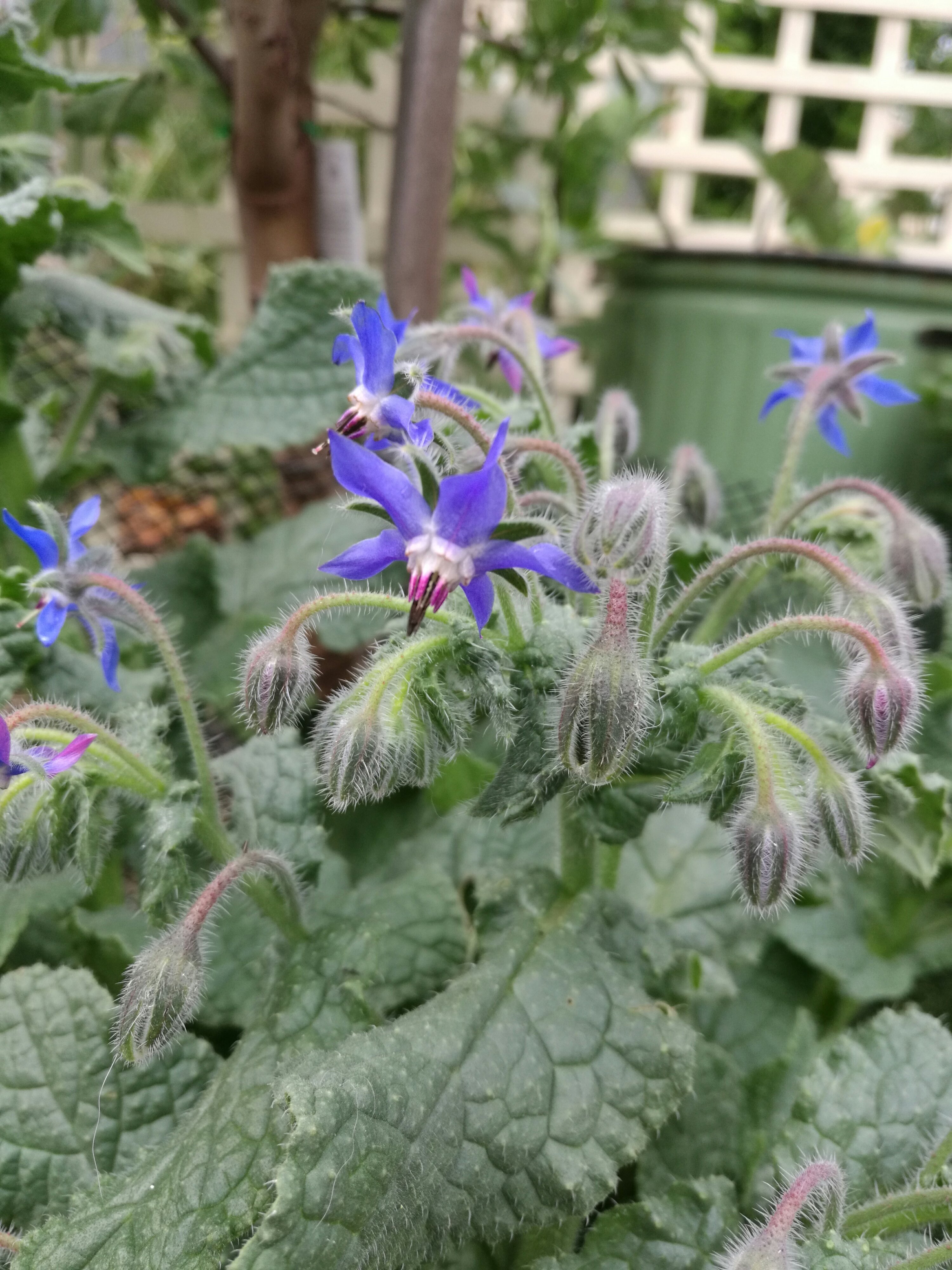
Common names: Borage, Starflower
Taxonomic name: Borago officinalis
Family: Boraginaceae
Area of origin: Mediterranean
Related Herbs: Comfrey
Can be used for: Cooling, soothing, relieving fatigue
Actions:
Tastes:
Tissue states:
Healing constituents : Aromatic oil, mucilage, resin, tannin, asparagine, sugars, minerals
Warnings: Contains pyrrolizidine alkaloids that can damage the liver in susceptible people who can pronounce them
Description
Annual to 1 metre tall. Thick, soft stems, oval leaves that are covered with short hairs’. Upright flowering stems that bear clusters of 5 petaled flowers that are usually blue/purple but can occasionally be pick/white. The flowers have black anthers standing upright in the centre.
Medicinal use
Borage (Borago officinalis) has a cooling, soothing nature and you may have noticed from my previous posts that many of the herbs that flower in early Summer are soothing and cooling – and as I write this, it’s just coming into the time of year when we need just that.
This cooling, soothing nature means that you can use Borage around inflammations, redness, soreness, rashes. I see something in the Doctrine of Signatures here, the rough, bristly leaves can bring out a rash in some people, and freshly crushed Borage leaves will soothe that and other rashes.
Borage also contains a compound that is a refrigerant. That means that it can help lower body temperature without causing a sweat. Usually, we use diuretics or diaphoretic herbs to release excess temperature from the body through urination or sweating respectively. There are some cases when neither are applicable – we had neighbours once who’s children were born with a condition where they had no sweat glands. Introducing their Mum to Borage went a little way to relieving their discomfort in Summer.
Borage has uses beyond its wonderful cooling effect. It is also a gentle way to recover from fatigue, as it helps to soothe and restore overworked adrenal glands. These glands are also the source of steroids that help moderate our body’s inflammation response. It helps the kidneys to function better at cleaning too. Traditionally, Borage is a symbol of courage. Its beneficial effects on the adrenal glands could go some way to making someone a little braver.
Like many other soothing herbs, Borage contains a mucilage that is easily accessible. It’s better to get it by making a cold infusion. This will benefit inflamed membranes, inside and out and can help in cases of hay fever or cystitis that occur this time of year.
So, Borage is another plant that is easy to grow and is ready just when we need it. I like it’s pretty blue, pink and white flowers too. Interestingly, the pink or even sometimes white flowers that occur on a single plant are a genetic mutation that won’t affect their healing properties.
Moderation in all things though, it’s related to Comfrey and contains pyrrolizidine alkaloids (try saying that three times quickly) which, in large quantities can damage the liver. A couple of cups of Borage teas a day won’t hurt though and may just do you a world of good.
How we use Borage at Ligaya Garden
We occasionally use Borage flowers and finely chopped young leaves to make a pleasant addition to cooling Summer salads. The cucumber like taste of the leaves shows through nicely. Borage flowers make a spectacular addition to drinks and are easily frozen into ice cubes for a striking display. Medicinally, I prefer a succus of Borage over other methods of preparation as the fresh juice is so nice to drink in small amounts. Dried as a tea, it stores well but there’s nothing like fresh Borage! For soothing remedies, I prefer to prepare dried Borage as a cold infusion in preference to hot for many purposes as cold helps draw out the mucilage better. As a hot tea, it helps with complaints of the upper respiratory tract and support for adrenals.