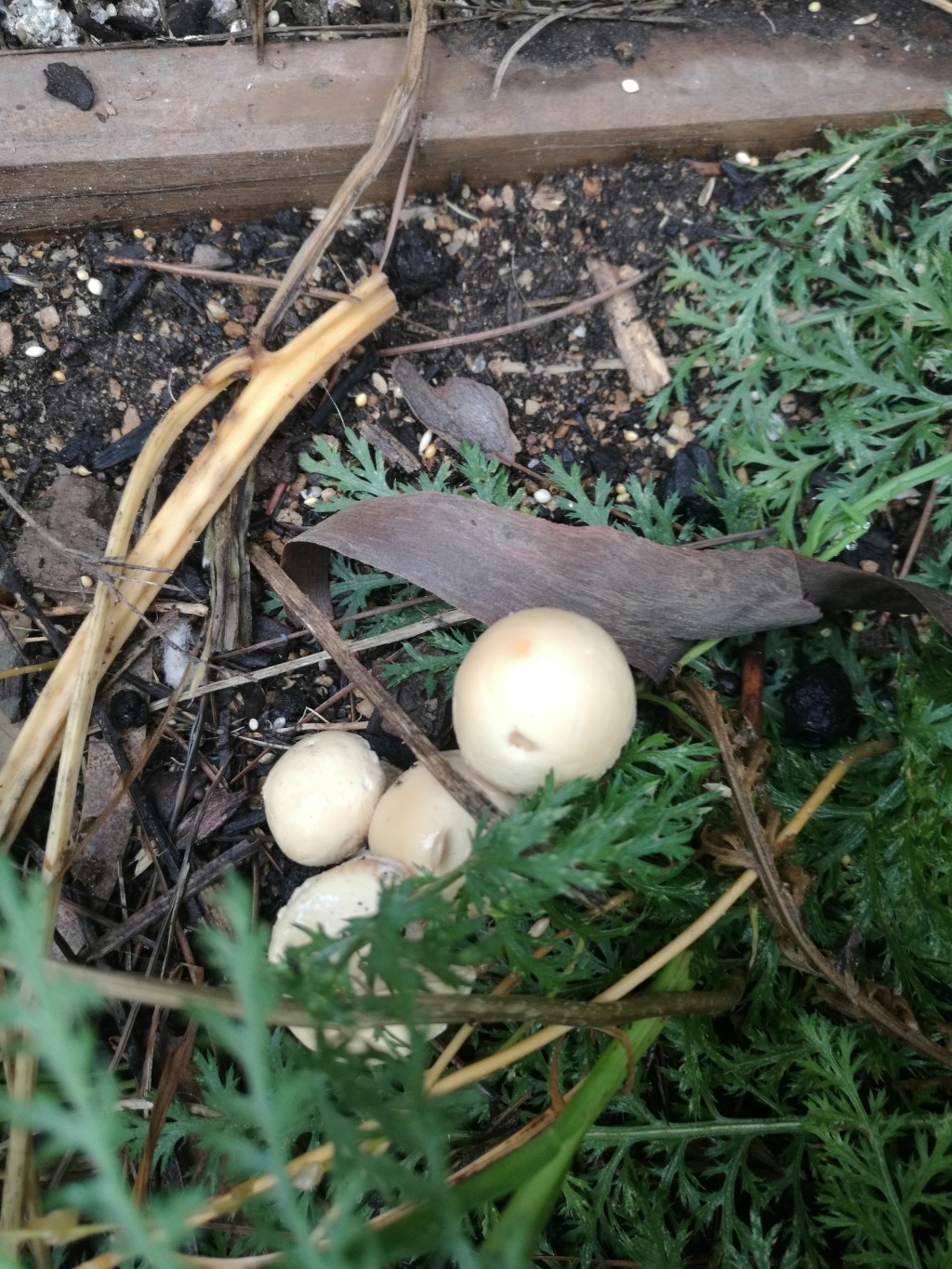

There are several different species that go by the common name of ‘Puffball’. These include Calvatia, Bovista, Lycoperdon and Vascellum spp. Puffballs are so called because of their roughly spherical shape and because when the spores are released or the ball is broken, the spores puff out in a cloud – the ‘puff’.
Interestingly, these spores have a medicinal use in herbalism. They are water repellent and when applied to weeping wounds and sores, help to repel the moisture and dry the wound. They can form a protective, water repellent crust over a wound – a natural bandage.
Puffballs are edible when the inside is a soft, white mass. As it matures, the inside of the Puffball will turn a brown colour and will harden. Once that starts to happen, the taste changes and it becomes practically inedible. Of course, if you pick one that is brown, don’t try to eat it.

Puffballs grow in as many types of location as there are species. They grow in lawns (loving ovals and sports fields), on straw in our garden (for several years, they seemed to love our Mugwort patch), at the sides of paths and in woodlands. I must say that those found in grass taste the best.

Identifying Puffballs –
If you see a white globe that isn’t a golf ball, look for these details –
- Round, or globular shape (may be mildly deformed)
- 2 – 10 cm in diameter (Calvatia can apparently get to softball size)
- White to light brown colour skin both outside and in
- Bovista have an outer coating which flakes off in pieces leaving a smooth skin capsule. They also have a root-like attachment.
- Lycoperdon have an upside-down pear or club shape and when young, a spiny surface.
- Vascellum have powdery outer coating which rubs off easily.
- There may be spines or scales, warts or even cracks but as long as the skin is unbroken, its OK if, when cut open, the inside is soft, white and marshmallow like
- There is no sign of the word ‘Spalding’. If there is, you have a golf ball!
If you find a mushroom that fits most of the above requirements, you have yourself a Puffball!

Caution: Though it is fun to get an older Puffball to puff, don’t inhale the spores. They are water repellent and can coat your upper respiratory tract possibly causing discomfort, breathing difficulties and coughing and asthmatic symptoms. This holds true for any mushroom but is especially true of Puffballs because of the way the spores come out.
For reference, Lycoperdon and Vascellum start on page 104 of ‘A field guide to Australian Fungi’ by Bruce Fuhrer.