Caution.
This mushroom can have some bad effects if not prepared properly. I am updating this page with the medicinal properties I am comfortable with from experience.
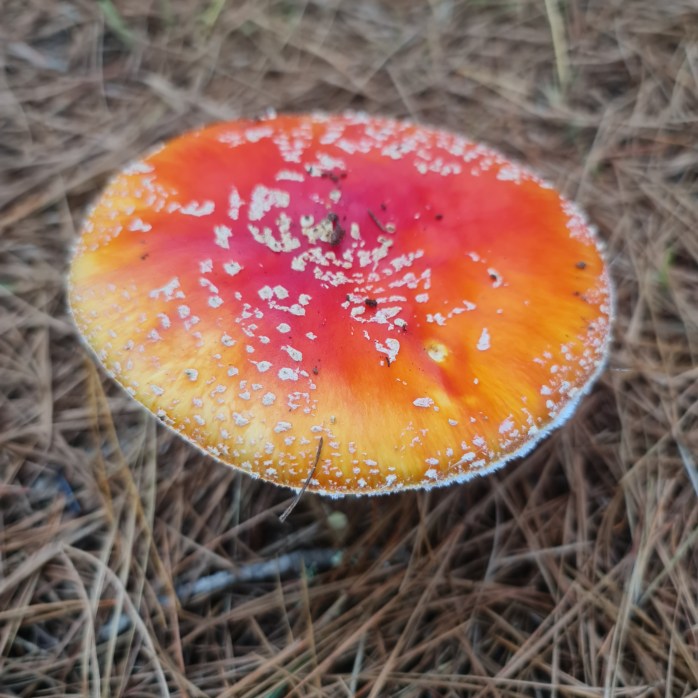
Division: Basidiomycota. Class: Agaricomycetes. Order: Agaricales. Family: Amanitaceae
Fly Agaric is one of the fungi that people think of when we mention mushrooms. Its bright red cap is very distinctive, and this fungus has a long association with humans, especially at Christmas time. It also makes an awesome pain-killing tincture for external applications.
The Christmas story and The Amanita
Amanita muscaria has a long association with humans, being used pretty well around the world (wherever it can grow) for traditional healing and spiritual processes. It is pretty common in Europe (the genetically original strain comes from Russia). It is so common and distinctive that folks often think of it first when they think of toadstools’. It has a long association with our Christmas celebrations.
If you stop to think about our Christmas iconography, you will think of Santa as a jolly fellow in Red who distributes presents that end up under our Christmas trees. But there is far more to it, and much of it relates to this fungus. How does Amanita muscaria relate to Christmas, then? Well, the story starts a long time ago, in Lapland, where some of our Christmas celebrations come from, especially the red and white colours that dominate the festive season.
Amanita muscaria contains a hallucinogen, but it is also quite toxic. Laplander Shamans learned that the toxic aspect of the mushroom’s chemistry was neutralized when Reindeer ate the mushroom and urinated out the compounds. Shamans could also eat the mushroom and urinate out the good stuff. People could even drink the hallucinogen urine, urinate it out, drink it and repeat the process. Yuck!
Shamans feature heavily in this aspect of the story and travelled the countryside by sleighs that were pulled by reindeer who ‘pranced’ and may or may not have been tripping.

In the old days, Santa travelled with the Devil. Santa rewarded good children, while the Devil punished those who had been naughty by taking them away for punishment, which apparently involved a lot of tickling.
Laplanders dried Amanita mushrooms by hanging them on Spruce trees (our Christmas decorations). Due to heavy snowfall during the winter months, these folks lived in yurts and entered and exited their homes through a door in the roof because the ground-level entrances were often snowed in. Travelling Shamans had to enter homes in this way (Santa entering the ‘chimney’ in later versions of the story).
The Shaman would enter the yurt and tell stories, heal and perform various spiritual activities, some of which may or may not have included the imbibing of hallucinogen-laced Reindeer urine.
From all that, you can see where some of the brighter aspects of our Christmas iconography come from and how they relate to this striking fungus.

They can get pretty big!

Amanita muscaria makes an excellent pain-killing tincture for external use.

White Gills.

The white scales are easily removed, even by the elements.

Gills free from the stem, crowded with lamellulae.

White flesh, hollow stem.

Distinct annulus, yellowing at the edge, maybe toothed.

Veil tearing to form the annulus.

You may need to dig deep to find the base.

Volva in concentric rings around the stem at the base.

The mushroom’s much prettier than me!
Medicinal properties
Besides its well documented hallucinogenic effects, Fly Agaric can be used medicinally in other ways. A tincture of Amanita muscaria is known for its ability to rapidly soothe the pain of sciatica. Just put a couple of drops where the sciatic nerve leaves the spine.
A tea made from Amanita is a wonderful way to get a good nights, very restful sleep but donýt forget to set your alarm clock!
I’ve found that eating dried Amanita in small amounts can ground me in the present when my mind is wandering. It was called ‘the time mushroom’ in some Indigenous groups around the world. Interestingly, the taste is rather meaty.
There are videos and posts online that show the preparation of an oil from dried Amanita caps but I’ve not found that to work. I think its because the constituents in an Amanita are primarily soluble in water and not oils.
Negative effects
Ingesting Ibotenic acid or Muscimol in any amount can have some negative effects. These include headache, nausea, trembling, shakiness, hallucinations, blackouts, coma and even death.
Identifying Fly Agaric (Amanita muscaria) – a summary.
If you find a bright red mushroom under Pines, check it for these features –
- Bright red cap with white scales in perfect specimens. Can be more toward orange or yellow with age and exposure.
- Cap starts hemispherical then planar as it opens up. Mature cap edges uplift with age.
- White to yellow scales (warts) on the cap are easy removed by rain, wind and contact. Sometimes veil remnants on or around the cap.
- White gills, free from the stem. Crowded and lammelule (little gills in between the bigger gills) are common.
- Flesh is white and doesn’t discolour with bruised.
- Stem is bulbous at the base and tapers toward the cap.
- Stem surface is smooth or can be slightly wooly.
- White stem with definite annulus. Annulus is often yellow edged and toothed or ragged. Disintegrates with age.
- Volva (covering at base of the stem). May be in concentric, deteriorating rings around the lower part of the stem above the bulb. You may need to dig a little to find it.
- Button stage is enclosed in a universal veil that becomes the volva.
- Spore print white.