

I don’t consider myself any particular authority on herbalism but am often asked at workshops, coffee shops and in people’s gardens about how to learn herbalism when it’s such a huge field. So I thought I’d share some semi-structured thoughts on the topic.
If you’re ever intimidated about remedy making, remember that practice makes perfect and herbalism is an art that , as a herbal proverb goes – ‘takes seven lifetimes’ to master. Even for this one, mortal lifetime, there is an overwhelming amount of info about herbalism and health in general and some of it seems to conflict, adding to the confusion. In the old, old days, one would learn only a very few plants in detail and those would be local plants that had been used to make remedies by people in your area for years. In other words, this meant that it was easy to get advice on using them from people you already knew about plants that you already knew.
Modern learning
Nowadays, though, much learning is a little less personal, it being online where you may or may not know the presenter. Or you may learn through workshops like ours or even this website. Add to that the plethora of information about herbs that you may never see in real life and you have a recipe for confusion and overwhelm. You can’t just go out and have a close look at a thriving specimen of some exotic herb like Cat’s Claw in the wild unless you live in specific areas of the tropica and how ever much you may read about it or hear through podcasts and video, you will probably never get to see it in the natural environment in which it has evolved and grown to handle the environmental stimuli that have produced its healing energies and constituents.
Much information is presented visually and some of us don’t learn well from videos, me included. So don’t be worried until you find your preferred ‘delivery’ method. A lot of info will slide on by you until you have found it in the format that connects with you. I love written text, in real life hard copy books and can watch a video ten times before the same amount of info as a single scan of a page sinks in. You may be the same or prefer audio or even song. Then there are the experts! So many experts! Most with something to sell.
We also expect to learn at a much faster rate than in the old days. Even the curricula of well respected schools has been streamlined in order to produce, in their student, a practitioner that can open their own business, rather than a herbalist with deep knowledge of their craft.
Access to too many herbs?
This is also a point at which many folks get confused. Aren’t all herbs good? As mentioned above, learning used to be done hyper-locally, within one’s own community and geographical area. Nowadays, we have access to so many herbs, whether dried and prepared or sold to us as plants by local garden centres or even online. Even though these living plants may be of excellent quality, just because it’s been grown to maturity, doesn’t make a herb medicinal. We had a great example of that recently when a local herb grower with the magic touch changed career paths and sold (?) her stock techniques to a far more commercial garden centre. The result was healthy herbs, for sure but with a diminished healing quality in them.
Herbs from other locations or even continents that you grow in your own garden may not have the potency of wild harvested herbs from their natural location. Be prepared for that when you are harvesting your own or purchasing commercially sold herbs. Even herbs from similar locations have different characteristics. The Calendula from the Kapunda Community Garden (Hi Dave, thanks for being a loyal subscriber!) makes a better oil than the same herb from my own garden while the opposite is true when making a tincture. Only experimentation over several years has given me that insight.
In the workshops I give, I recommend people to start with one plant. Before you start reading about it, spend a day sitting with it, touch it, smell it, taste it, talk to it, listen to it. Watch where it grows and how it responds to moisture, sunlight or voice. Get to know it through your senses (they call that ‘organoleptically’). Remember how it has grown since you planted or met it in the wild.

How does the smell make you feel. Are you happier with the leaves, roots or flowers. Does its character change when Bees are on it? All of these things are what I did with my first herbal ally, Lavender. Then start to read about it, but don’t just read, go through the same sensory process again and again as your technical and medicinal knowledge of your plant grows and watch how many more insights you get into its nature.
Use your senses before you hit the books
When thinking about it medicinally, think about your own ailments and those of your family and research those specifically. Don’t try to absorb a database of a zillion ailments that the herb is ‘good for’ but look at how you can use it immediately with yourself and your loved ones. This will point you to which kind of remedy to make as well. Rather than theoretically learning about and making tinctures of half a dozen herbs that you might rarely use, think about how you would like to physically apply that herb to any ailment of those around you. In the case of Lavender, once again, I started making litres of Lavender tincture because of the wide range of ailments that esteemed herb can be used ‘for’. Nowadays, I only use it in that form in my chronic pain remedy but use it almost exclusively otherwise as an oil or ointment. If I’d followed that process that I have developed, I would have saved myself a lot of time and expense- alcohol is expensive! Though I did learn how to make a damned good Lavender tincture!

Be playful too. It’s easier to learn that way and to investigate your personal sensations and responses to a herb. Do you just love its taste or smell or do they repulse you? Both are indications of something worth exploring. You don’t have to dream or have visions about a herb to learn about it just examine your own immediate feelings and sensations. The spiritual stuff will grow as you do.
Herbal styles
There are different styles of herbalism too, some focusing on chemicals with long, confusing names (you’ll grow to love them eventually) and some focused on observation and experience. There are schools of thought that reduce the plant to the status of a machine that makes chemicals just for us to use while other schools elevate and honour the plants as unique individuals that are here to heal us physically while guiding us spiritually. I started with the first but have moved along the spectrum to the latter now. I won’t say which one is better because I do love the chemistry as much as the energetics.
Even within the broad divisions of energetics and chemistry are a wide variety of styles and techniques that have been stolen from other cultures in the past and appropriated into modern healing. Or, in a much better turn of events, have been more gently introduced by practitioners as our cultures have melded.
Now we have access to centuries of cultural and medicinal knowledge from all around the world, we have to decide which is most suited for us. In the past decade or so, a trend has emerged of staying within your herbal lineage. That means to look at the herbalism from your own culture as your primary source. This makes sense because we have evolved with the plants that have grown with our culture and our intimacy with them is coded into our genes. Also, growing up, you may have experienced both the plants and the knowledge of how to use them either directly or anecdotally through your Elders. Even if, as a rebellious teenager, you chose to ignore your Grandmother’s talk of the benefits of Lavender, that knowledge is inside you, ready to come to consciousness. Staying close to one’s lineage doesn’t mean that you can’t or shouldn’t investigate or use the healing methods of other cultures, it makes your early learning much easier if you are working with something that has been encoded into your body and soul for generations. Acknowledging your herbal lineage also helps you acknowledge that much current herbal knowledge was stolen from its original sources and puts you in a better place to work with that.
You may find a deep calling to work with the healing methods of other cultures and that’s fine. It’s very good in fact because by acknowledging your personal herbal lineage, you can then work to bridge the gaps and help decolonise herbalism and heal damage done in the past or present.
Technology
The pic below is of my progression and increasing skill level when infusing St. John’s Wort into grapeseed oil. On the far left is a very insipid looking 2018 batch, the middle, 2023 and the far right, this year’s (2025) much more potent brew, almost obscenely red.
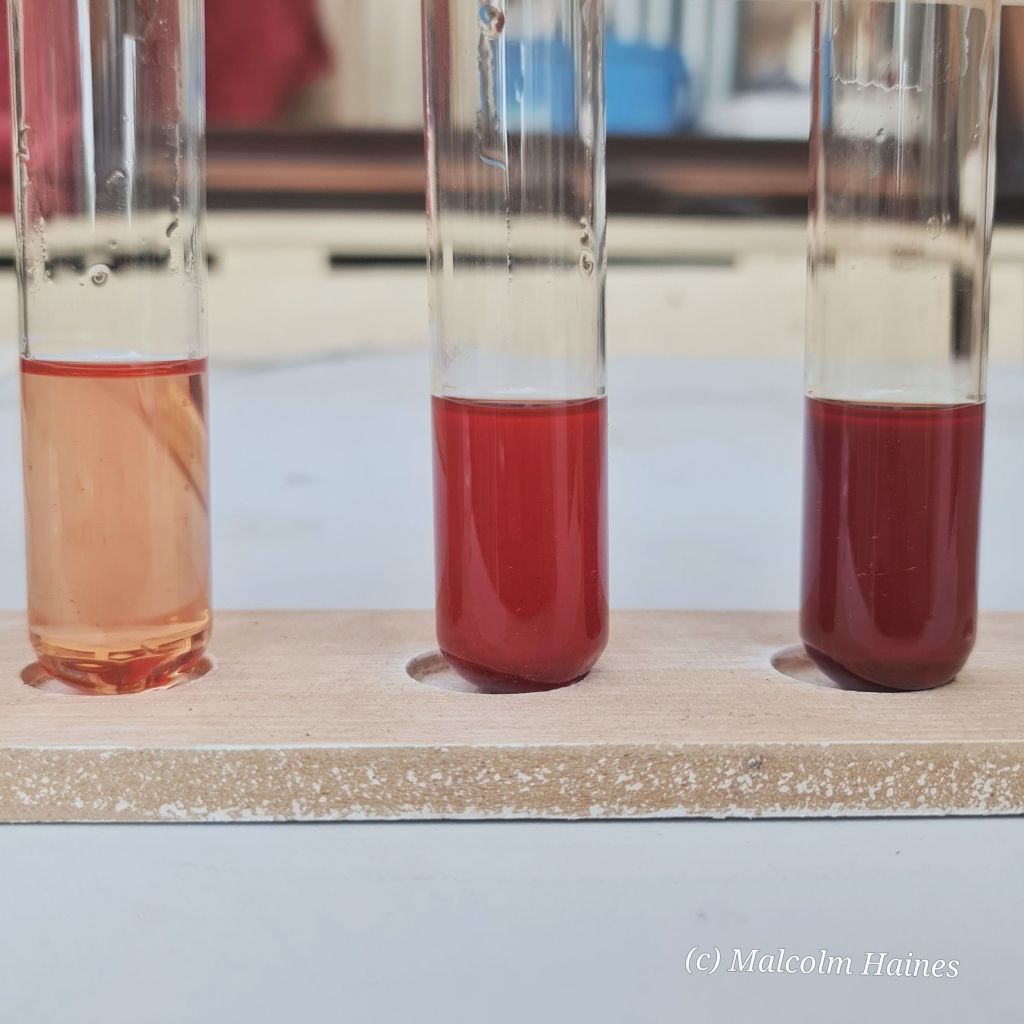
The first two were made in the traditional month, while the last was produced in 5 days, with the 5th day being dedicated to experimenting to find out exactly how fine a filter I can use. 450 mesh for this one,
Nowadays, with blenders that can reduce the materials of herbal plants to dust far more effectively than the traditional mortar and pestle and blend more thoroughly than a spoon or ladle would have done in more traditional times, it is easier to make remedies in less time. Greater surface area of the herbal parts and a faster, stronger blending and mixing of herb and solvent can cut the time for making a remedy in at least half. If you add the fact that we have more control over heat in our kitchens, sheds or labs, we can maximise the effect of that aspect of remedy making. Also, we have clocks and timers that are far more accurate than an old school herbalist could have dreamed of, which allow us to be free from the moon as our timekeeper (though she does have many other blessings she shares with the astute herbalist) and also the ability to automate some parts of the making process, freeing us up for other, hopefully better, things.
There are some amazing authors who have written on remedy making and once you have a few of their books you may notice that – guess what? – they don’t always agree on techniques, times or quantities. I won’t mention any specific examples because I want you to be free of bias on your journey and If I mention one over another, it may stick with you and cloud your judgement before you find your own sweet spot. The books that I frequently refer to are included on our bibliography page. Check them out, have a look on Amazon and see if a Kindle version is available. Don’t buy it up front, rather download the free sample and have a look at that to see if it gels with you. It’s what I always do if they’re available in that format, I especially look at the index and how comprehensive it is. If you like the book, invest in a kindle or hard copy. If you buy a real life book, you don’t have to buy from evil Amazon, there are many other suppliers around. Fishpond is my favourite.
If you’re finding this information useful, share it with your community
Like everything in herbalism, remedy making takes time and practice. I’m not one for keeping notes, so my progress may have taken longer than the journey of some, more organised folks. Herbalism and gardening are, in this way, the same. Each takes time, patience, understanding and quite a number of mistakes but continual application of effort wins out every time. Errors are natural but as long as you have some kind of record, you should never make that particular error again (maybe). Our little garden and apothecary have seen many small disasters in their growth, some more spectacular than others – I remember my first effort at Beet Kvass that painted our kitchen ceiling blood red (don’t tell Jelina about that one)! I’ve made brews with the wrong concentrations and have had to be creative in finding other ways to utilise the result. That leads me to a tip – never throw away a remedy that you think you’ve stuffed up. Instead, finish making it, then examine it closely using all of your senses. Try using it, first for its intended purpose, then for other purposes that you may think of. Do a little research and you may be amazed at the connections you will make with your remedy and other potential; uses. That’s how I discovered that we can use tinctures to make oils.
When making your early remedies, only make small batches. Don’t be tempted to make gallons of everything.
Plants tell you quickly when they’re not happy. When I have something to plant, I’ll try to remember what I know about the plant and what it likes, then I’ll sit it in a few suitable places throughout a day or two and see where it seems happiest. That’s where I’ll plant it. It’s been a good system so far, with few errors that I think were caused by not taking the time to calm my mind first and rushing the job. Making the remedies from the plants though, is a little different because without a little experience behind you, it can be trickier to gauge how one is going until it is finished. That’s why you need to make more notes than I do.
How do we weave it all together?
In writing the above, I’ve tried to emphasise finding your own path through a massive forest of information, material and tradition. It sounds glib to say that, but that is what you will need to do. Sometimes, I used to feel like I was drowning in information and failing at turning it into knowledge at the rate that I expected. Then I realised that in an ocean or lake I can swim in whichever direction I want and its all the same body of water. I realised then that sometimes setting out in a certain direction is counterproductive to learning and now just let it all flow. Some of the water was fed into the lake by one stream, other knowledge was delivered by others but they all ended up in the same body of water for a while, awaiting transformation. I used to try to pound facts into my head as I did when I was young but now read and think and what’s still in my head the next day is what I was meant to have learned. It is retained much better too.
If you need more structure than I, take a course. I don’t mean a full degree or anything but a short course such as are often offered online for free or only few dollars. This will give you an introduction to the topic and guide you through the steps in a manner that the presenter and the platform found beneficial. A while ago, I was stuck in exactly that place, so took 2 short online courses at $27 each that brought my searching mind to a place where it could adda little structure to my learning. Workshops are great too. That way you get to meet the presenter and get to know if their style (not just their information) is for you.
You’re not just learning about herbs, you’re really earning about yourself.
Borrow books and read widely, look at free information from the online schools. Really, what you should look for is not just factual content but what resonates with you. That could be your calling. Maybe herbal astrology will wave to you and say ‘let’s walk together for a while’. Maybe TCM, Ayurvedic medicine will be your go.
Also, don’t be afraid to change your style. Nothing is fixed. I started with reflexology and tissue salts, went through western energetics and now love the old school humoral approach to diagnosis. The thing is, they all work together in my personal style and nothing I’ve learned get s cut out or neglected for a long period of time. Sometimes the approach will be more chemical, other times more spiritual – it all works together in the long run, through you in your own style.
Other herb pages on Ligaya Garden
We cover a lot of ground on many herb related topics here on our website. There are whole pages devoted to different topics as well as frequent posts. Some of the links are –

2 responses to “Too hard? Too much info?”
Hi M Love your new post Malcolm both in the thoughtful way it is structured and the emphasis on a heart centred approach to learning which in my experience has a deeper more lasting impression and most importantly builds connection and relationship between yourself and Other, whether plant, human or animal.
Do you find that sometimes a plant that you may have ignored or not delved deeply into might catch your eye in someone’s garden as you walk past or on a roadside as you’ve driven past? For me these types of encounters often bring me the exploration of the medicine I need at that particular time.
I’m looking forward to the next sunny day when I am at work so I can make a Bellis essence- I don’t have enough flowers at home yet to make one there.
If ok with you I’ll forward your post to Raven she is just about to start clinic finally in her final year so if you know anyone who may want it reduced price naturopathy consult, she will be at Endeavour Wellness clinic on Fridays from July 11th-just ask for Raven when they book. Price is only $25 with any herbal remedies prescribed at standard rates but no obligation to buy.
Hope you are well have yo catch up for a cuppa soon!
G
Sent from my iPhone
>
LikeLike
Thanks G. I’m exploring more creative ways to write thoughtful pieces. I think my growing dissatisfaction with the website is linked to the fact that it’s just information, interpreted by me, of course but written to just inform people. I feel more of the need to express myself now.
Your Bellis essence will he excellent. You are very intuitive and will know just how to make it. Interestingly the Flower Essence Society dont list it in their repertoires. That only means that nobody’s written about it, not that it won’t work. Since you suggested it, I’ve been thinking about trying to make some myself.
You don’t need a lot of flowers, try with just a single one.
Congrats ti Raven for making it this far. Practicum is an exciting stage in the journey. I’ll let people know about her availability. I did invite her to the Gawler Kitchen Herbalists Facebook group. She’s welcome to post about her work and study experiences there.
Coffee’s a definite!
LikeLike