Roots are strong, tough, resilient and sometimes very hard. They take a little more effort to harvest and prepare than other plant parts.
Some plants have deep taproots (Plantain, Dock) and others have finer, widespreading roots (Ashwagandha, Mallow), but unless you are lucky enough and the Earth is on your side so that you can pull up a whole plant, roots and all, they mean some digging.
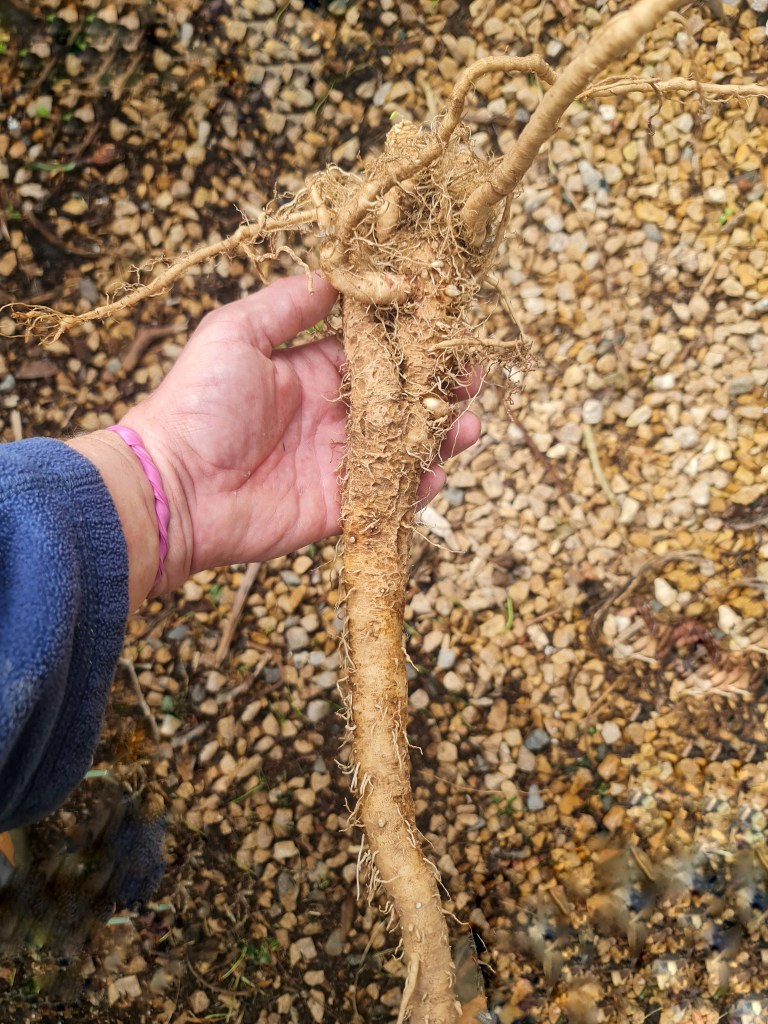
If the plant is an annual or a short lived perennial, you can dig out the whole plant. Perennials, like trees, shrubs and bushes need a whole lot of digging and you must be careful to leave a goodly amount of root in place so that the plant can continue to live.
Timing
Timing is important in digging roots. I’ve written about how a plant’s energy cycles through different parts of a plant throughout the day and the seasons. I’ll recap that a little, here, as it is important for maximising the potnecy of your herbs.
Starting in the morning, a plant’s energy rises from the roots to the stem and leaves, then to the flowers as the day progresses. As the day fades, the cycle reverss.

It’s a similar cycle with the seasons and can be seen best in deciduous trees. In Spring, the energy rises from where it was stored the previous Autumn, it rises to the trunk, then the leaves, as they start to bud. Once the leaves have formed, the plant can start producing energy for itself from the sunlight. When the time is right, energy goes into forming flowers and, after pollination, fruit. Once the fruit has formed, the energy reaches a climax and the plant enters a stale time. As sunlight begins to wane and the temperature slowly drops, energy and resources are withdrawn from the leaves, photosynthesis slows to a stop and energyand resources are sent to the roots for storage. With spring, the winter dormancy breaks and the cycle starts again.
A TCM perspective
We can see this in the Yin and Yang balance and the 5 transitions of Chinese Medicine. Some folks call the transitions ‘elements’ but that suggests a fixed nature to them, which isn’t the case. I called them that for ages because that was how I learned them but now, I use ‘transitions’.
Winter is the deepest Yin and is represented by the Water transition. As Yang increases and Yin wanes in Spring and the plant’s energy grows and begins to move upward, we move into the Wood transition. In Summer, Yang is at its peak and Yin is lowest, temperatures have risen and we are in the Fire transition. Late Summer is when things start to slow a bit and reach a fairly stable stage. This is the Earth transition. Autumn is when Yin starts to increase and Yang diminishes, it is a time of change and letting go. We call this the Metal transition and it is a state of change. After Metal comes the solidity and quiet of maximum Yin, the Water transition again.
Just like the energy in a plant, each waxes and wanes in a cycle. None are fixed. Yin and Yang aren’t fixed either. We can best see them as proportions. Nothing is fully Yin or Yang, each reaches a maximum or minumum but one is never without the other.
Plants store their energy in their roots during the Yin periods, the evening and the Winter. These are the best times to harvest. Actually, I wait for the very first signs of seasonal warmth or the day’s morning energy to harvest. I just don’t like the idea of damaging a sleeping plant, prefering to wait until it stirs.
Most of the time, you will need to wait at least into the plant’s second year before harvesting the roots. That gives them time to establish and store a goodly amount of energy in their below ground parts. Golden Seal and Licorice can be harvested in their 3rd year and I’ve been told that Astragalus must wait four.
After you’ve dug
Once you have dug up your roots, you need to clean them thoroughly. Naturally, coming from the Earth, they will be covered with it. A good wash and then a scrub with a scrubbing brush is on order, then another rinse, then another scrub – you’ll be surrprised at how many times you may need to repeat this until your rinse water comes off clean.
Some roots of softer herbs as Yarrow are chewed fresh after digging and washing (great for temporary relief of toothache) but most will need further processing before you can use them.

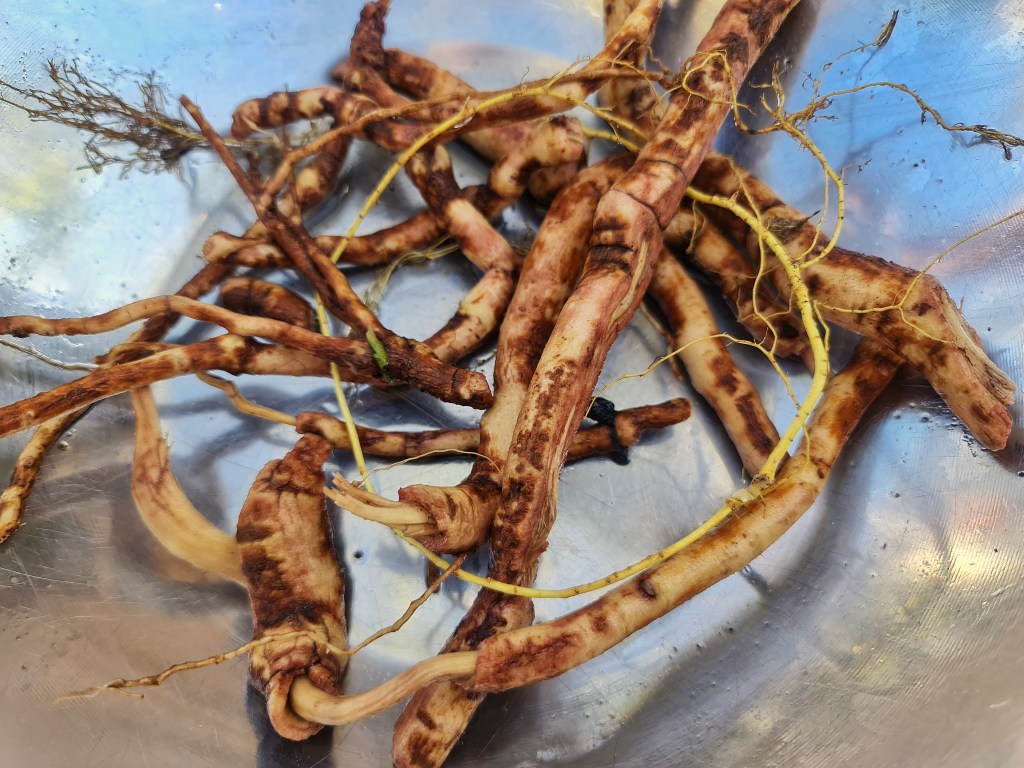
Some roots have a distinct outer layer that peels off easily. Don’t throw that away, it contains the toughest part of the roots and can add a lot to your remedies. Most plants store their bitter and other herbal constituents in the outer, protective layer while they store their straches and carbohydrates in the softer, inner portion.
Pat them dry, then leave them to air dry for a little before chopping them up. Some roots are slippery until dry so it pays to wait until you can handle them easily.
Chop them while they are fresh. Don’t fall into the thinking that you’ll be chopping them when they’re dry – with some roots that’ll be near impossible! Use secateurs or a good, heavy knife or chopper for cutting up your roots – they can be tough, so always use a chopping board or such and use caution always. ⚠️
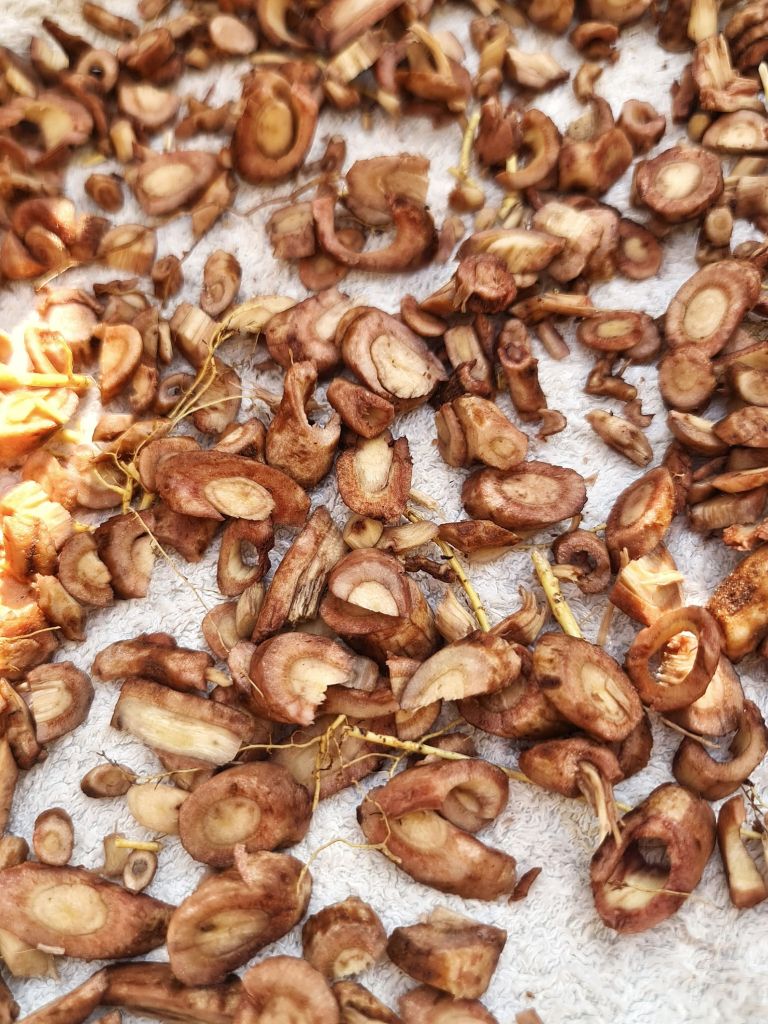
I like to cut my roots at an angle so that the pieces come off in a lozenge shape, with the maximum surface area on each side. Sometimes you’ll have to chop the root into shorter lengths and even split them lengthwise before slicing them into their final shape.

If your root is going to be powdered, cut them even smaller. – that will save your grinder or blender’s blades.
Drying some roots can take a while. Even those sliced thinly will take several days in Summer to air dry. Think weeks in the cooler weather. I like to air dry mine for a few days before even thinking of putting them into an electric dryer.
Roots have such a potent concentration of energy and constituents that for some plants, such as Valerian, you need to store them somewhere out of the way for a year before thinking of using them herbally. This allows the constituents, which may be at toxic levels st the start, to break down to a safer form or level.
Store your roots as you would any other plant part – in a cool, dry place, ot of direct sunlight and away from critters.
A good rule is to never powder any herb part before storing, keep it in reasonable sized chunks. Powdering the herb is great for increasing the surface area available for extraction by our solvents or making the constituents more accessible by our digestive system but it also exposes more of them to air and breakdown through oxygenation and possibly moisture.
How to use your herbal roots
After all that effort digging, washing, cutting and drying, you will want to use your herbal roots properly.
You can powder any root or bark material (such as Cinammon) and mix them in with food. You can also add them to smoothies but that can taste foul! Adding the pieces that you prepared as above, in a small muslin bag, into soups and stocks that you are cooking is the classic Asian way of adding medicinal virtues to your food.
Generally though, the best way to use root material directly is by boiling and simmering for a time in a technique called ‘decocting‘. That method breaks down the tough cell walls and allows for the best extraction of most constituents.
Some roots such as Licorice have constituents that are water soluble and Marshmallow is famous for its soothing mucilage that is best prepared as a cold infusion, as are other mucilaginous herbs such as Comfrey
Other herb pages on Ligaya Garden
We cover a lot of ground on many herb related topics here on our website. There are whole pages devoted to different topics as well as frequent posts. Some of the links are –